Three everyday practices you will see from the first hour in Lhasa.
Prayer flags
The small rectangles in five colours, blue, white, red, green and yellow, are printed with prayers. They hang on passes, rooftops and bridges, and wind is believed to carry the prayers outward. Old flags are left to fade rather than thrown away.
Prayer wheels
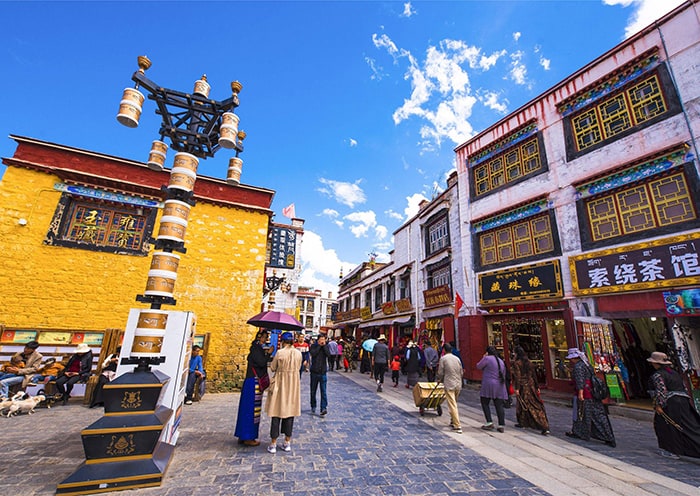
Prayer wheels hold rolled prayers inside a drum. You turn them clockwise with your right hand as you walk past. In Lhasa they line the walls of the main temples and monastery paths. Spin them gently and keep moving.
The kora
A kora is a circuit around a temple, a mountain or a lake, always clockwise. The best-known is the walk around the Jokhang on Barkhor Street, where pilgrims walk, spin wheels and recite mantras from before dawn. Walk slowly in the flow, and do not stop in the middle of the path to take photos.
Haz
- Walk clockwise
- Spin wheels gently with the right hand
- Leave old flags to fade
- Keep the flow moving
No hagas
- Walk against the pilgrims
- Step over prayer stones
- Take flags home from a pass
- Block the path for photos
Frequently asked questions
Can I hang a flag?
Ask your guide. They can tell you where and how, and how to do it respectfully.
Why clockwise?
It is the direction used in Tibetan Buddhism for circling sacred places.
Can visitors join the kora?
Yes. Pilgrims are happy for visitors to walk quietly with them.