Home / Tours / Tibet Group Tours

7 Days Lhasa to Kathmandu Overland Group Tour with Mt. Everest (Gyirong Exit)

  • TD-TGT-G
  • 7 Days
  • Tibet Group Tours

Expedition Overview

Want overland tour from Lhasa to Nepal? Travel in small group with our 7-day Lhasa to Kathmandu overland tour, visit Lhasa, Yamdrok Lake, Everest Base Camp, and exit from Gyirong Border to Nepal. Best local price, 4-star hotels.

Lowest Price Guarantee. Reserve Now and Pay Later.

Explore Tibet in EFFICIENT way – start in Lhasa and end at the Gyirong Border. This is one-way overland group tour from Lhasa to Nepal border. You’ll admire Mount Everest up close while saving both time and cost. There’s no need to return to Lhasa, making it the perfect choice for travelers heading onward to Nepal.

Compared with the 8-day Lhasa to Mount Everest Base Camp tour, this 7-day Lhasa-Kathmandu overland group tour saves a full day by traveling directly from EBC to the Gyirong Border.

Your adventure begins with 3 days in Lhasa, where you’ll explore the city’s spiritual and cultural landmarks, including the iconic Potala Palace, Jokhang Temple, and Sera Monastery (Monks’ debate). You’ll also enjoy hands-on experience making Tibetan incense at the Lhasa Traditional Handicraft Art Center. Then, travel along the famous Friendship Highway to Shigatse, passing turquoise Yamdrok Lake, glittering Karola Glacier – two of Tibet’s most stunning natural wonders. Make a stop at Yamdrok Lake for special hot pot arranged by us!

Make your way for adventure to Everest Base Camp, the closest point you can reach to the world’s highest peak. Really cool experience!

Your dedicated guide will accompany you all the way to Gyirong Port, ensuring smooth border procedures before you journey onward into Nepal. Now, select your date and travel with us! Best local price provided!

Itinerary

Tashi Delek! Welcome to Lhasa, the capital of the Tibet Autonomous Region! Upon arrival at Lhasa Gonggar International Airport or Lhasa Railway Station, our friendly Tibetan guide will greet you with a Hada (a traditional white silk scarf) and warm blessings. (Tip: Please let us know your mode of transportation and arrival time in advance.)

After that, our guide and driver will escort you to your hotel in downtown Lhasa. (Tip: The airport is located about 60 km southeast of the city, 1-1.5 hours’ drive.)

After check-in, take the rest of the day to relax and acclimatize to Lhasa’s high altitude (3,650 m). It’s important to allow your body to adjust before beginning your exciting journey through Tibet.

Helpful Reminders for Your First Day in Lhasa

  • Take a good rest and stay calm.This is the best way to prevent altitude sickness.
  • Avoid strenuous activity and you’d betternot take a shower on the first night to prevent catching a cold.
  • **Do not drink alcohol.**Instead, drink plenty of water, eat fruits, and avoid heavy meals.
  • If you wish, you can prepare herbal or oxygen supplements such as Rhodiola, American ginseng lozenges, or Gaoyuan’anto help with adaptation.
  • Always follow the advice of your local guide. If you feel unwell, inform your guide and seek medical attention promptly.

Today, enjoy hands-on cultural experience at the Lhasa Traditional Handicraft Art Center and gain deeper insight into Tibetan Buddhism by witnessing the monks’ debating session at Sera Monastery.

IIn the morning, immerse yourself in traditional Tibetan arts at the Lhasa Traditional Handicraft Art Center. Take part in making Tibetan incense, practicing Tibetan calligraphy, and learning the secrets of traditional woodblock printing.

Tibetan incense is commonly burned as an offering during Buddhist ceremonies and rituals. Its ingredients often include juniper, sandalwood, cedarwood, cinnamon, cloves, and a variety of medicinal herbs.

In addition to crafting incense, you can observe the full process demonstrated by the local artisan, who will teach you Tibetan calligraphy and help you write your own name or blessing in the Tibetan script. This makes for a meaningful keepsake to bring home as a memory.

In the afternoon, take a short drive of about 7 km (20 minutes) to visit Sera Monastery, one of the three great Gelug university monasteries in Tibet. Here, you’ll experience Tibetan Buddhism up close.

The highlight is the monks’ debate, held daily from around 15:00 to 17:00 (except Sundays). This lively intellectual exchange involves one monk standing and asking questions, while others sit and respond. The standing monk’s gestures – such as palm-slapping and foot-stomping – symbolize activating wisdom and are not acts of aggression. You’ll also have the chance to observe prayer ceremonies, explore meditation halls, and learn about monastic life.

After the tour, be transferred back to your hotel in Lhasa.

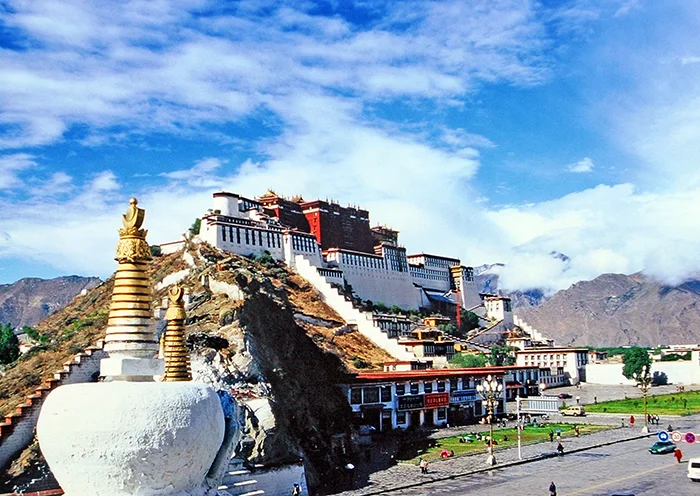
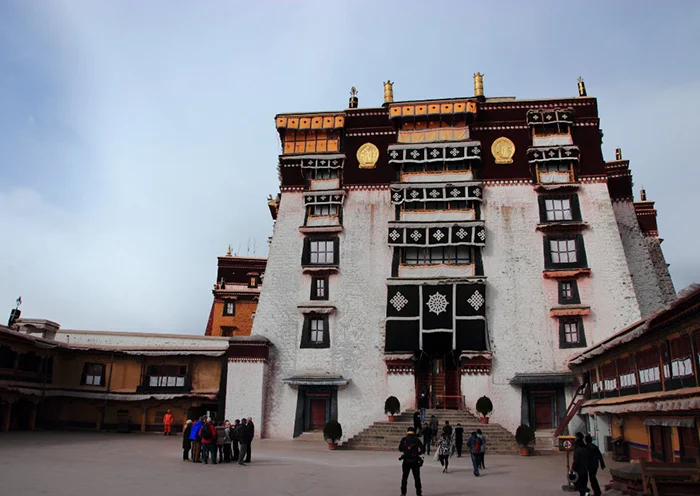
Today, it is the time to explore Lhasa by visiting the world-famous Potala Palace, a World Heritage site and the picture behind the 50 RMB. And then, you will explore Lhasa by visiting Jokhang Temple, a world cultural heritage site renowned for its brilliant architecture, culture, art, and history. Finally, you can stroll through the famous Barkhor Street with locals and learn more about the daily kora life of Tibetans.

This morning, you’ll first explore Potala Palace. This is the most iconic landmark of Tibet and the former winter residence of the Dalai Lamas (1649-1959).

After climbing 365 stone steps from the palace gate to the Red Palace, you’ll reach the highest ancient palace in the world – standing proudly at 3,700 meters above sea level – and enjoy stunning panoramic view of Lhasa city.

As you wander through the halls, chapels, and sacred shrines that honor past Dalai Lamas, you’ll be captivated by the intricate murals, exquisite carvings, dazzling jeweled decorations, and the deep spiritual atmosphere that fills the air. Inside the Potala Palace, countless Tibetan pilgrims can be seen bowing and praying devoutly – for many, visiting this sacred site is the journey of a lifetime.

Your guide will also share fascinating stories about King Songtsen Gampo, the 33rd ruler of Tibet, who originally built the Potala Palace in the 7th century to honor his marriage to Princess Wencheng of the Tang Dynasty.

Potala Palace Visiting Tips:

  • All visitors must enter as part of a guided group and can stay inside for a maximum of one hour.
  • Tickets are issued under a real-name reservation system. A valid ID or passport is required, and once reserved, rebooking is not allowed within 7 days.
  • Entry times are assigned randomly by the Potala Palace Administration, and it’s not possible to choose your visiting hour.
  • During peak season, your travel group may be split into smaller sub-groupswith different visiting times or guides.
  • Photography is strictly prohibitedinside the palace.

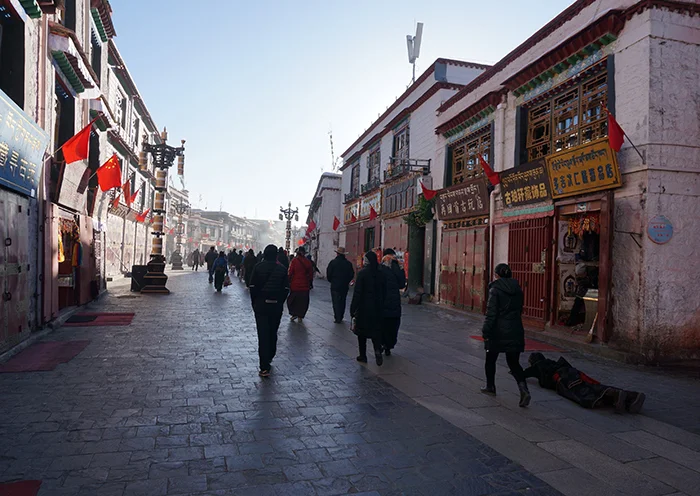
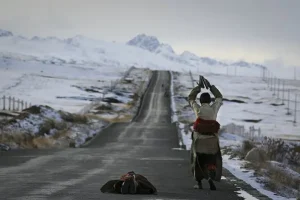
Next, your group will visit Jokhang Temple, the spiritual heart of Lhasa with a history of more than 1,300 years. From afar, you’ll see countless devoted pilgrims prostrating in front of the temple. Stop for a while to witness this moving sight and the unwavering faith of Tibetan Buddhists. This will be a moment to touch your soul.

According to legend, Jokhang Temple was built by King Songtsen Gampo for his two brides – Princess Wencheng of China and Princess Bhrikuti of Nepal. The name Jokhang means “House of the Buddha,” and the temple enshrines a life-sized statue of the 12-year-old Sakyamuni, one of the most sacred treasures in the Buddhist world. This makes Jokhang Temple the holiest pilgrimage site in Tibet.

Take time to explore the temple’s intricate architecture – admire the colorful murals, ornate decorations, and fine carvings that showcase the essence of Tibetan craftsmanship. From the second floor, you can enjoy a panoramic view of the bustling Barkhor Street below.

Visiting Tips for Jokhang Temple:

  • Visiting time: about 1 hour.
  • Admission requires real-name reservation through the “Jokhang Temple Reservation” WeChat between 7:00–23:59 for the next day. Reservations are limited, so please book in advance with your guide’s assistance.
  • Jokhang Temple is an active religious site. During important religious ceremonies or special events, access may be restricted -your understanding is appreciated.

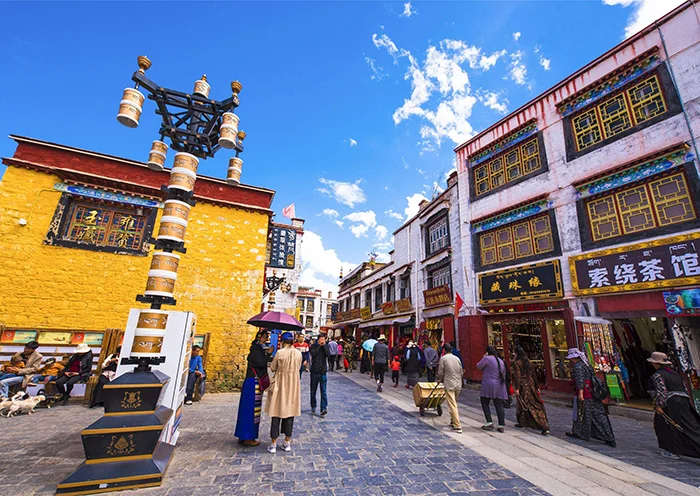
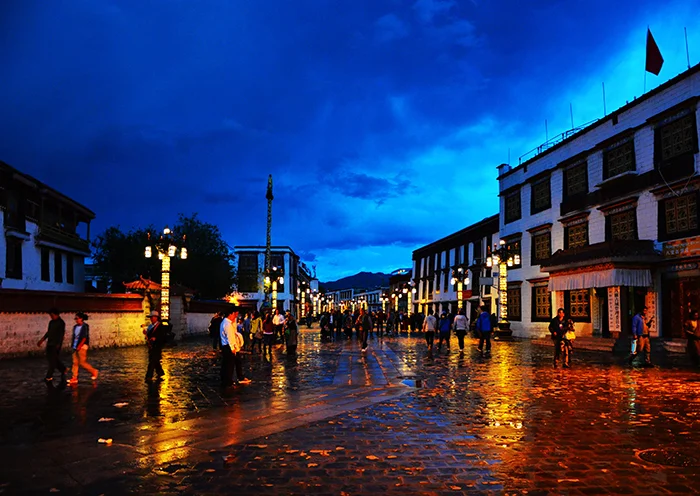
After the visit, step outside to Barkhor Street, once the traditional kora (pilgrimage circuit) around the temple. Today, it’s a lively place filled with the scent of incense and the sounds of chanting pilgrims. You can sip yak butter tea at a teahouse, dress in Tibetan attire for photos, or shop for unique handicrafts and souvenirs from Tibet, Nepal, and India.

Special Meal Arranged by AOT:

In the evening, enjoy a group dinner featuring delicious Tibetan or Nepalese cuisine, specially arranged by the AOT team.

After the tour, be escorted back to your hotel in Lhasa.

Today, you’ll embark on a scenic drive from Lhasa to Shigatse, Tibet’s second-largest city. The journey covers around 370 kilometers and takes 7 hours’ drive, with stops to admire two of Tibet’s most spectacular natural wonders – Yamdrok Lake and Karola Glacier.

In the morning, after about 2-3 hours of driving (110 km), get your camera ready as you approach Kampala Pass (4,797 m). Here, you’ll be rewarded with a breathtaking panoramic view of Yamdrok Lake, a turquoise ribbon shimmering among snow-capped mountains. Known as one of Tibet’s four sacred lakes (along with Lhamo Latso, Manasarovar, and Namtso), Yamdrok is believed to hold spiritual power – helping Tibetans locate the reincarnated soul of the Dalai Lama. You’ll also see locals offering photo opportunities with Tibetan mastiffs, yaks, or goats dressed in traditional ornaments.

Specially Arranged Meal at Yamdrok Lake by AOT:
Take a break at Yamdrok Lake to enjoy a special Hot Pot arranged by Asia Odyssey Travel. Fresh dish, stunning lake views, totally get relaxed. Also have time to take beautiful photos before or after your meal.

In the afternoon, continue driving for about 1.5 hours (87 km) to reach the stunning Karola Glacier (5,012 m) – one of Tibet’s three major continental glaciers and a filming site of the movie Red Valley (Hong He Gu). Backed by Naiqin Kangsang Peak (7,191 m), the glacier gleams like a frozen waterfall cascading right beside the highway. You can enjoy the view from your vehicle or take a short, easy walk to the glacier’s base. Across the road, admire the majestic snow-capped Mount Kalurong – another highlight of this alpine wonderland.

Tips for visiting Karola Glacier:

  • The alitude here is about 5,012 meters, so move slowly and avoid overexertion.
  • The public toilets are very basic -be prepared.
  • Some locals may charge a small fee for taking photos with them or their animals -always confirm before photographing.

Afterward, drive about 3.5 hours (170 km) through Gyantse, aalong the wide Nianchu River Valley, passing through scenic Tibetan villages, vast barley fields, and golden rapeseed flower fields (in summer). Upon arrival in Shigatse (altitude: 3845 meters), check into your hotel and rest well.

Warm Reminder:

For foreign and Taiwan travelers, registration at the Shigatse Entry & Exit Administration Office is required. Your guide will assist with the process and may adjust the schedule accordingly – please follow their instructions and cooperate as needed.

In this morning, your group will first explore Tashilhunpo Monastery, the spiritual heart of Shigatse.

Founded in 1447 by Gyalwa Gedun Drup, the 1st Dalai Lama and a disciple of Tsongkhapa, Tashilhunpo Monastery is the largest monastery in Tibet’s Tsang region and one of the six great Gelug monasteries alongside Drepung, Sera, Ganden, Labrang, and Ta’er. It has long been the traditional seat of the Panchen Lamas, the second-highest incarnation lineage in Tibetan Buddhism after the Dalai Lama.

At its height, the monastery housed over 5,000 monks and included more than 3,000 rooms, 50 affiliated temples, and 30 manors and pastures. Today, you can still sense its grandeur as you explore its vast complex of prayer halls, courtyards, and golden roofs glinting under the sun.

Highlights of Tashihunpo Monastery:

  • Admir the Maitreya (Future Buddha) Chapel, which enshrines a magnificent bronze statue of the Maitreya Buddha -made with over 115 tons of copper, 250 kg of gold, and adorned with more than 1,400 precious jewels including diamonds and pearls.
  • Pay repect to the sacred stupas (reliquary chortens) of successive Panchen Lamas, exquisitely crafted with gold, silver, coral, pearls, turquoise, and silk.
  • Enjoy a panoramic view of Shigatse city and the serene monastic life, where monks in crimson robes chant sutras echoing through the halls.

After the visit, your whole group will drive from Shigatse toward to Mount Everest (Qomolangma), the highest mountain on Earth. Along the way, admire the stunning transformation of the landscape as you ascend toward the Himalayas.

Gyawu La Pass – the Everest Viewing Platform

Follow the famous 108 switchbacks along the Everest Road to reach Gyawu La Pass (5210 m), also known as the Everest Viewing Platform. On clear days, this is one of the few places on Earth where you can see five of the world’s highest peaks above 8,000 meters lined up before you – Everest, Lhotse, Makalu, Cho Oyu, and Shishapangma. The panoramic view is awe-inspiring, with the mighty snow peaks stretching endlessly across the horizon.

Rongbuk Monastery – the Highest Monastery in the World

Continue to Rongbuk Monastery (5154 m), nestled at the foot of the Rongbuk Glacier. It is the highest monastery in the world, belonging to the Nyingma school of Tibetan Buddhism, and is home to both monks and nuns. The monastery is divided into old and new sections – the old one preserves meditation caves believed to have been used by Guru Padmasambhava, while the new section offers a spectacular view of Mount Everest’s north face. The white chorten and mani stones at the entrance make for iconic photo compositions – quiet, sacred, and timeless.

Everest Base Camp – Touching the Summit of the World

Standing at 8,848 meters, Mount Everest straddles the border between China and Nepal in the central Himalayas. The endless glaciers, hanging ice cliffs, and snow-covered ridges create a view of rare beauty and grandeur.

Then, head to Everest Base Camp (EBC, 5200 m) – the closest point ordinary travelers can get to the world’s highest peak. Surrounded by tented lodges, EBC stands just 19 km in a straight line from Mount Everest’s summit. Here, you can truly feel the majesty of the mountain – towering, powerful, and humbling. Many visitors describe this as a once-in-a-lifetime experience, with Everest’s sheer presence leaving an unforgettable impression.

Warm Tips for Visiting EBC:

  • FromEverest Town (50 km from EBC), travelers must transfer to the eco-friendly shuttle bus for the final stretch to Base Camp, and return the next day the same way. Your main driver and vehicle will not accompany you – please bring all essentials with you.
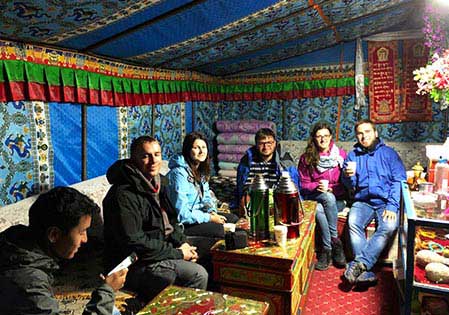
  • Accommodationat EBC is in tented camps (reconstructed in 2025) with improved facilities, now offering twin rooms and a simple dining tent. However, amenities remain basic with shared bathrooms. Supplies are limited due to high altitude, so please be understanding.
  • During winter, if the tent camp is closed due to weather, the group will stay in a guesthouse in Everest Town(or called Tashizom Town) (with private bathroom).
  • The altitude and temperature can be extreme -even in summer, nighttime temperatures may drop to 08°C. Please dress warmly or rent a down jacket at Base Camp if needed.

Wake up to the crisp morning air at Everest Base Camp. Take a quiet moment to appreciate the majesty of Mount Everest and the surrounding Himalayas. If you like, begin your day with gentle yoga or meditation to refresh your body and mind, or enjoy a peaceful walk around the base camp for closer views of this extraordinary landscape.

Tip: If weather permits, you can enjoy the Golden Summit view – one of the most breathtaking sights on Earth. The best seasons are spring (April–May) and autumn (September–November), when the skies are usually clear. You’ll need to rise early and take a short hike to the viewing point to see the snowcapped peaks glowing golden in the morning light.

After saying goodbye to Mount Everest, your group will depart from Everest Base Camp and travel to Gyirong Town – where Gyirong Port is located – following part of the famous Friendship Highway, also known as the China–Nepal Highway.

Along the way, you will have the chance to admire the majestic and awe-inspiring Mount Shishapangma, located about 120 km from Mount Everest near the Nepal–Tibet border. Standing at 8,027 meters, it is the 14th-highest mountain in the world and the only 8,000-meter peak located entirely within Tibet. Its towering summits, massive glaciers, and surrounding lush valleys and grasslands create truly spectacular scenery.

The route continues across the desolate plains of Digur Tang, where vast sand dunes contrast strikingly with the snow-covered peaks of Shishapangma and Langtang to the south. As you leave the Bum-chu Basin, you will descend toward the beautiful turquoise Pelkhu-tso (4,590 m), the largest lake in Shigatse. Mount Shishapangma is regarded as a sacred mountain, while Pelkhu-tso – shimmering like an emerald at its base – is considered a holy lake, the pair enhancing each other’s beauty.

Make a stop at Gyirong Valley, where the scenery shifts dramatically from barren highlands to lush greenery, allowing you to feel the remarkable change in climate and vegetation.

Stay overnight in Gyirong Town.

Today, after breakfast, your 7-day Lhasa–Shigatse–EBC–Kathmandu Overland Group Tour comes to an end.

You and your group will be smoothly transferred from Gyirong Town to the Gyirong Border, where your guide will assist you with the border-crossing procedures before you exit China.

Travel Note:

Zhangmu Port currently operates mainly for freight, while Gyirong Port serves as the primary port for tourism. The Friendship Highway is an 800-kilometre scenic route connecting Lhasa, the capital of Tibet, to the China–Nepal border at the Sino-Nepal Friendship Bridge between Zhangmu and Kodari.

Thank you for choosing Asia Odyssey Travel for your Tibet Group Tour. We look forward to welcoming you on your next journey!

Make an inquiry

Free inquiry. No payment required. We reply within 24h.

Accommodation & Hotel Condition for Your Tibet Tour

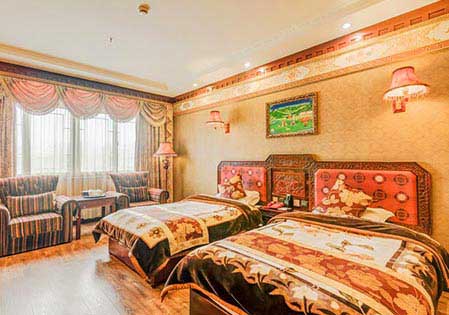
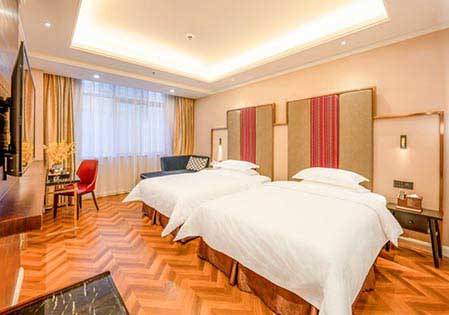
Have a good sleep everyday is very important during your China tour. In a private tour, you can decide on your own which hotel class you want – luxury 5 starcomfortable 4-star or economic 3-star.
All the hotels in each destination we selected are at good location, close to commercial street or tourist attractions. And, all the hotels we use have a business relationship for many years and they have windows, air-conditioners, hot water, showers, wifi… (except for basic accommodation condition when travel to Mount Everest) to ensure you luxury and comfortable sleep experience. The staff can speak English and they will provide you the high quality service. If you have any requirements, you can ask them to help.
What’s Included & What’s Not Included

•  The price is based on a group tour for 2 people sharing one standard double-bed room in comfort hotels.
•  Price varies depending on travel date, group size, hotel class, program in your itinerary and possible fluctuation of currency exchange rate.

What’s Included

Transportation
•  Regular licensed tourist vehicles (7–26 seats).
•  If there are fewer than 4 travelers for Lhasa city sightseeing, your guide will accompany you by taxi, and the taxi fare will be covered by the travel agency.
•  This is a join-in group tour, so changes of vehicles or guides may occur. Thank you for your understanding.
•  Due to Tibet’s limited tourism infrastructure, vehicles are generally older than those in mainland cities.
•  Most vehicles do not use air conditioning, as high altitude and temperature differences can cause mechanical issues and increase the risk of catching a cold.
•  There are driving speed limits in certain regions of Tibet (e.g., specific sections must not be completed in less than two hours). Your driver may stop at random points for rest or waiting—please be patient and enjoy the scenery.
•  When joining a group, pickups may involve waiting while collecting guests from multiple hotels. Please be punctual; if you voluntarily give up any day’s travel, the vehicle fee cannot be refunded.
•  Luggage policy: To ensure safety and comfort at high altitude, each traveler may bring one 26-inch suitcase and one small backpack. The guide will assist in storing excess luggage at your Lhasa hotel if necessary.

Accommodation
•  Standard twin rooms in basic hotels (double occupancy). Single-bed rooms (king-size) are not guaranteed; no extra bed or breakfast is provided for travelers not occupying a bed.
•  In case of odd-numbered travelers, the agency may arrange triple rooms, room-sharing, or charge a single supplement.
Fixed hotels are pre-arranged for group tours; specific hotel requests cannot be accepted.

Meals
•  Daily hotel breakfasts included.
•  Onecomplimentary local specialty meals (non-refundable if not used):
Lhasa Specialty Meal (Tibetan or Nepalese cuisine)
Other meals are self-arranged. If you are unaccustomed to Tibetan food, you may bring your own side dishes.
•  Complimentary meals may be arranged as lunch or dinner.

Guide Service
•  Chinese-speaking, English-speaking, or bilingual (Chinese-English) guides.
Guides are arranged according to the group composition. If both Chinese and English speakers are in one group, a bilingual guide will be provided.
•  In shared group tours, guide or vehicle changes may occur – your understanding is appreciated.

What’s Not Included

Single Room Supplement
•  Tour prices are based on twin-room occupancy (except for dormitory-style rooms).
•  If you require a single room, an additional single supplement fee will apply.

Hotel Changes or Hotel Cancellation Loss
•  Since hotels are prepaid in full, no refunds will be issued for any unused nights or itinerary changes after check-in.
•  Any damage to hotel property or extra charges incurred will be the traveler’s own responsibility.

Personal Expenses
•  All personal expenses are not included, such as:
Laundry, telephone, fax, or pay TV
Drinks, snacks, tobacco, or alcohol
Any other items or services of a personal nature

Unforeseen Circumstances
•  In case of force majeure or events beyond the control of the travel agency (such as natural disasters, war, strikes, epidemics, flight delays or cancellations, or insufficient group size),the agency reserves the right to cancel or adjust the itinerary.
•  Any extra costs incurred as a result will be borne by the traveler.

Transportation to and from Tibet
•  The tour price does not include flights or train tickets to and from Tibet. If you would like the travel agency to assist with booking, additional costs will apply.

Cancellation Policy

In the event that you need to cancel your trip, please ensure that you submit a written cancellation request. The calculation of cancellation fees will begin from the date we receive your written request.
The cancellation fees will be calculated as follows:

• If the cancellation is made between 45 and 30 days before the scheduled departure date, a fee of 10% of the full payment per person will apply.

• If the cancellation is made between 29 and 15 days before the scheduled departure date, a fee of 30% of the full payment per person will apply.

• If the cancellation is made between 14 and 7 days before the scheduled departure date, a fee of 50% of the full payment per person will apply.

• If the cancellation is made between 6 and 0 days before the scheduled departure date, a fee of 100% of the full payment per person will apply.

Important Trip Notes

All foreign travelers are required to obtain a Tibet Travel Permit to visit Tibet. The permit can only be applied for through a registered travel agency in Tibet (we are local based Tibet travel agency with office setting in Lhasa) and is required to purchase flight or train tickets to Tibet. The permit is necessary to enter Tibet and visit certain areas within the region, including Lhasa and Mount Everest Base Camp. Travelers should plan ahead and allow sufficient time for the permit application process, as it can take one to two weeks to obtain the necessary permits.
All foreign travelers are advised to make their bookings at least one week in advance and send the necessary documents to us for obtaining the permits. However, if you plan to visit Mount Kailash, it is recommended to book at least two weeks in advance, as it may take longer to obtain the necessary permits.

Typically, small group tours in Tibet will have 1-16 travelers, and you will have the opportunity to meet and travel with tourists from different parts of the world. This can be a great chance to make new friends and connect with people from different cultures and backgrounds.

Yes, if you are traveling with a group of friends or with your family, you can customize your own group tour. Please contact your professional travel consultant to discuss and arrange a customized group tour that meets your needs and preferences.

 
•  “B” stands for breakfast. You will have it at your hotel in the morning.
 
•  “L” stands for lunch. The restaurants we will arrange for you are all designated tourist restaurants approved by local tourist administration bureau. All are in good sanitary conditions. Lunches are usually included if you have a full day tour in one destination. Your guide will assist you with ordering the dishes. If you will travel from one city to another, lunches are excluded and you can ask the guide for some suggestions about where and what to eat.
 
•  “D” means dinner. All dinners are excluded in the itinerary. You have the chance to taste some authentic Chinese food and local snacks.
 
•  If you have special dietary requirements (vegetarian, halal, kosher, Indian, or gluten-free), please let us know before your booking. We will try our best to take care of you.

Book Your Expert-Led Tibet Discovery

Ready to see Tibet differently? Join our specialized local team for an authentic, high-altitude experience designed to go far beyond the typical tourist route. With vetted logistics, expert local guides, and a passion for deep cultural immersion, we guarantee a journey that is as safe as it is transformative. Secure your spot today—your path to the heart of Tibet starts here.

Expert-Guided Cultural Deep-Dive

Not just tours, but true immersion. Unlike generic sightseeing, our routes are crafted by local scholars and Himalayan experts. You aren’t just visiting landscapes; you are entering stories, gaining insights into Tibetan history, Buddhism, and plateau life that remain invisible to the standard traveler.

Authentic & Transparent Journey

Zero commercial pressure. We believe your pilgrimage belongs to you alone. We strictly adhere to a 100% No Shopping Stops policy, ensuring every moment of your precious time is spent exploring sacred heritage and breathtaking nature—never in a commercial trap.

Perfectly Paced Exploration

Slow travel in high-altitude comfort. We prioritize both your safety and your experience. Our itineraries are masterfully paced for high-altitude acclimatization, blending iconic ‘big wow’ landmarks with secret, hidden gems, allowing you to breathe in the plateau’s serenity without ever feeling rushed.