What is a Tibet festival tour?
A Tibet festival tour is a fixed-date itinerary timed to a specific Tibetan religious or cultural calendar event. The four canonical festivals on Tibet Daily’s schedule are Losar (Tibetan New Year, lunar Jan), the Saga Dawa full moon (lunar April), the Shoton Festival (lunar June, secular August), and the Nyingchi Peach Blossom Festival (early April). Each draws a different cohort: Losar attracts those wanting cham dances and the Lhasa family rhythm; Saga Dawa pulls Buddhist pilgrims and serious trekkers; Shoton brings monastery-art devotees and opera audiences; the peach blossom festival is the most visually accessible for first-time Tibet visitors.
Most festival tours run 5 to 9 days. They are typically priced 15–30% above the equivalent non-festival route because hotels and yak-pony hire spike, and because departures are capacity-limited (Drepung’s hillside fills before sunrise on Shoton; Tarboche on Saga Dawa is a single-track approach).
| Festival |
2026 dates |
Where |
What you see |
| Losar (Tibetan New Year) |
Feb 18–20, 2026 |
Lhasa, Tsurphu, monasteries |
Cham dances, family kora at Jokhang, household altars |
| Nyingchi Peach Blossom |
Apr 1–9, 2026 |
Niyang River valleys |
Two weeks of pink blossom at 2,900 m |
| Saga Dawa (Buddha) |
Jun 11, 2026 |
Mount Kailash, Lhasa |
Tarboche flagpole raising, Kailash kora pilgrim wave |
| Shoton Festival |
Aug 13–19, 2026 |
Drepung, Norbulingka |
24 m thangka unveiling at dawn, Tibetan opera |
When to go and how long to plan
Festival dates follow the Tibetan lunar calendar and shift annually relative to the Gregorian — confirm 12 months ahead. Saga Dawa is the full moon of the fourth Tibetan lunar month, which usually falls in late May or early June. Shoton is the 30th day of the sixth Tibetan month, usually in early-to-mid August. Losar is Tibetan New Year, computed independently from Chinese New Year and usually 4–6 weeks later.
Permit lead time is 25 working days for Saga Dawa Kailash departures (Aliens’ Travel Permit + Military Permit) and 15 working days for Lhasa-based festival tours. Hotels fill ahead: book Saga Dawa by October the year before; Shoton by April; Losar by November; Nyingchi Peach Blossom by mid-October.
How we run Tibet festival tours at Tibet Daily
For Saga Dawa we depart Lhasa 5–6 days before the full moon to put travellers at Darchen by lunar 14th, walk the Tarboche flagpole ceremony at dawn lunar 15th, then begin the kora. For Shoton, we hold a Drepung hillside spot from 04:30 on the unveiling morning so travellers arrive to a reserved seat at 06:00. For the peach blossom festival, we depart Lhasa by train and base in Bayi to catch the Suosong viewpoint at sunrise. For Losar, we keep travellers in Lhasa for a private Tsurphu cham dance and a family-hosted lunch in the old town.
What we don’t do: we don’t quote festival tours as identical to off-season equivalents (the price honestly reflects the spike); we don’t promise a clear thangka-morning view if Drepung’s hillside fog won’t lift; and we don’t sell festival add-ons that cut acclimatisation days from a Kailash route.
Frequently asked questions
How much does a Tibet festival tour cost in 2026?
The 9-day Shoton Festival group tour with EBC starts from USD 1,353 per person. The 5-day Tibetan New Year (Losar) tour from USD 720. The 9-day Nyingchi Peach Blossom group tour USD 1,456. The 14-day Saga Dawa Mount Kailash overland from USD 2,200 per person. All include the Tibet Travel Permit, festival-day arrangements, Tibetan guide, 4WD or coach, and 4-star hotels.
What is Saga Dawa and why is it the busiest Kailash date?
Saga Dawa is the fourth Tibetan lunar month, marking the Buddha’s birth, enlightenment and parinirvana. Its full-moon day is the holiest day of the year for a Mount Kailash kora — Buddhists believe the karmic effect of one kora on Saga Dawa equals 100,000 koras on any other day. The Tarboche flagpole at the kora’s southern foot is re-erected by monks; tens of thousands of pilgrims walk the route in a single week.
What happens at the Shoton Festival?
Shoton (“yogurt banquet”) opens with the unveiling of a 24 m × 18 m thangka of Sakyamuni Buddha on a hillside above Drepung Monastery at dawn on day one. The remaining 5–7 days bring Tibetan opera performances at Norbulingka Park (the Dalai Lama’s summer palace), pilgrim picnics with yogurt, and monastery family visits. Originally a monastic post-retreat festival; now a public Lhasa event drawing 100,000+ visitors.
Is Losar (Tibetan New Year) worth visiting?
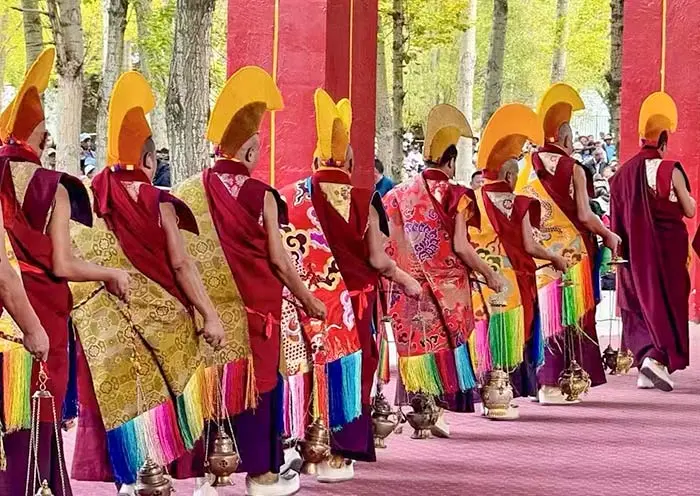
Yes for travellers wanting the family-rhythm Tibet, not the tourist Tibet. Lhasa empties of foreign visitors during Losar (mid-February); monasteries hold cham masked dances (Tsurphu on lunar 28th, Lhamoi Latso on lunar 30th); Tibetan families deck household altars with chemar boxes (barley flour and butter sculpture). The weather is cold (–10 °C nights) but dry and sunny.
Is Nyingchi Peach Blossom worth a dedicated trip?
Yes for travellers timing late March or early April. The Niyang River valley turns pink for two weeks; the Suosong viewpoint of Namjagbarwa is at its photographic peak when the lower altitude blossoms frame the snow peak. Most visitors pair it with a 4-day Lhasa block for acclimatisation. The 9-day group tour with fixed April 1–9 dates sells out by October the previous year.
Will I see real religious practice or staged performances?
Both, depending on the festival. Saga Dawa Kailash and Losar cham dances are unstaged religious practice with travellers as observers. Shoton’s thangka unveiling is genuine ritual; the opera performances are simultaneously religious and entertainment, with stylised costumes and historical dance lineage. Nyingchi Peach Blossom is principally a secular festival with music and food stalls.
Are festival tours suitable for families?
Losar and the Nyingchi Peach Blossom are family-suitable for children aged 8+. The Shoton Festival’s hillside dawn wait at Drepung is taxing for young children (06:00 start, no shelter, 100,000+ crowd). Saga Dawa Kailash is unsuitable for under-14s due to altitude. We recommend the 5-day Losar tour or the 9-day Peach Blossom for families.
How do I book a Tibet festival tour?
Decide the festival, pick the date (Tibetan lunar dates change each Gregorian year), and contact us at least 6 months out for Saga Dawa, 4 months for Shoton, 3 months for Losar, and by mid-October the year before for Nyingchi Peach Blossom. Permits begin on deposit; we hold festival-day hotels and Drepung viewing spots as soon as deposits clear.

 Tibet Festival Tours