Home / Tours / Chengdu Tibet Tours

10 Days Chengdu & Lhasa to Kathmandu Overland Tour via Qinghai-Tibet Railway

  • TD-FCD-013
  • 10 Days
  • Chengdu Tibet Tours, Tibet Private Tours

Expedition Overview

The 10 Days Chengdu and Lhasa to Kathmandu Tour is more than an overland adventure – it’s a journey from spice to spirituality. Start in Chengdu at the Panda Base, then board the iconic Qinghai-Tibet Railway. As you climb toward the plateau, you’ll watch the landscape transform into high-altitude grasslands and snow-capped peaks from the comfort of the world’s highest train.
After exploring the spiritual heart of Lhasa, your adventure continues overland through Gyantse and Shigatse. The highlight is a night spent near Everest Base Camp, where you can witness the first light on the mountain’s North Face. We handle every logistical detail – from Tibet Travel Permits to the private transfer across the Gyirong border – ensuring a smooth and secure entry into the Kathmandu Valley.

Itinerary

Nihao! Welcome to Chengdu, the Hometown of Giant Pandas! Our team will be ready for you when you arrive in Chengdu. Enjoy a trouble-free transfer to your hotel. The rest of today is yours to relax in panda city on your own.

Arrival Ideas:

Chengdu is well connected by air and high-speed rail. There are two airports – Chengdu Shuangliu International Airport and Chengdu Tianfu International Airport operating many international and domestic airlines. Travelers can go to Chengdu by air from most cities in China, like Hong Kong, Beijing, Shanghai, Guangzhou, Xian, Guilin, Hangzhou, Kunming, Lhasa, Lanzhou, Wuhan, Xiamen, Guiyang, Chongqing… In addition, travelers can take high speed train to Chengdu from Xian (3-4 hours), Chongqing (1.5-2 hours), Guiyang (3.5-4.5 hours), Kunming (6-6.5 hours), etc.

iRecommended Optional Evening Activities:
  • Watch a wonderful Sichuan Opera performance which includes face changing, spitting fire, hand shadows, puppet show, dancing, singing and acrobatics. (usually from 20:00 to 21:30).2)Appreciate the city’s night view by boat (30mins) along the Jinjiang River, which winds through central Chengdu. ( 18:00~23:30)

Your morning begins with a short drive to the Chengdu Research Base of Giant Panda Breeding. As the world’s largest sanctuary for captive pandas, it is home to over 100 residents of all ages. We recommend an early arrival to see the pandas at their most active-munching on bamboo or playing in the cool morning air.

If you visit in autumn, look out for the newborn cubs in the nursery houses. Beyond the giant pandas, you can also spot red pandas in their designated playgrounds and visit the Panda Museum. Your guide will share “insider secrets” about their conservation and daily lives.

Next, dive into Chengdu’s famous “slow life” at Renmin (People’s) Park. Often called the city’s living room, this is the best place to witness local culture firsthand. We’ll grab a seat at a time-honored tea house for a cup of fragrant green tea, watch locals play mahjong, and soak in the relaxed atmosphere.

Later, take a stroll through Kuanzhai Alley (Wide and Narrow Alleys). This historic block features a unique blend of Qing Dynasty architecture and modern lifestyle. It’s a vibrant hub for folk arts, boutiques, and street food. If you’re feeling adventurous, this is the perfect time to try local spicy snacks like dandan noodles or “chuanchuan.”

In the evening, our team will transfer you to the railway station for your journey to the “Roof of the World.” The Train No. Z322 departs from Chengdu West at 21:08. During this 37-hour scenic ride, you’ll witness the landscape transform into the high-altitude plateau.

iKind Reminder:

Please ensure your Tibet Travel Permit is easily accessible, as it will be checked before boarding. The Chengdu-Lhasa train runs every other day, so please confirm the latest schedule with your travel consultant.

You are riding on Qinghai-Tibet Railway – the world’s highest railway. Pull up a window seat to view Himalayan mountains, shimmering lakes, plains dotted with yaks and herders’ tents, and barren deserts, as you inch slowly up onto the high plateau. Keep your eyes peeled throughout the journey for antelope, foxes and wild asses, plus the occasional nomad.

Useful Tips:

Sleeping Berths: The train has four types of sleeping berths, including soft sleeper, hard sleeper, soft seat, and hard seat.

Dining: The train offers a variety of Chinese and Tibetan dishes in dining cars. If Chinese food is not to your taste, you can bring some instant food.

Toilets: The train has both Western-style and squat-style toilets available in each soft sleeper carriage. However, passengers should be prepared for their towels, toilet paper, and hand sanitizer.

Oxygen Supplies: When reaching to Xining, all passengers usually are required to transfer to another train that is equipped with an oxygen supply system to help passengers acclimate to the high altitude of the Tibetan Plateau.

Altitude: 3650m

After the morning on the train enjoying the views outside, the train finally arrives in Lhasa.

Tashi Delek! Welcome to Lhasa, the capital of the Tibet Autonomous Region! Upon your arrival at the train station in Lhasa, the tour guide and driver will meet you at the exit, and then escort you to the hotel in downtown Lhasa. You can have a good rest to get used to the altitude (3,650m) in your hotel and get ready to explore Lhasa with your guide the next day.

iKind Reminds:

1. It is good to avoid highland sickness by slowing down, keeping warm, drinking some water frequently, not showering for the first one or two days, taking it easy, and sleeping well.
2. You should always follow your doctor’s advice on altitude according to your health condition.
3. Be sure to let your guide or the hotel staff know whenever you feel unwell or need help. The people there are always willing to help and good at dealing with altitude sickness.

Altitude: 3650m

Your exploration begins at the Jokhang Temple, the spiritual heart of Tibet for over 1,300 years. This UNESCO site was built for King Songtsen Gampo’s brides, Princess Wencheng and Princess Bhrikuti. You’ll witness the profound devotion of pilgrims before the sacred, life-size Jowo Shakyamuni statue, considered the holiest treasure in the Buddhist world.

In the afternoon, we head to Sera Monastery, one of the three great Gelug university monasteries. You’ll have the unique opportunity to witness the famous Monks’ Debating (usually 15:00–17:00, except Sundays). Watch as monks use rhythmic palm claps and stomps to symbolize the activation of wisdom during their lively philosophical exchanges.

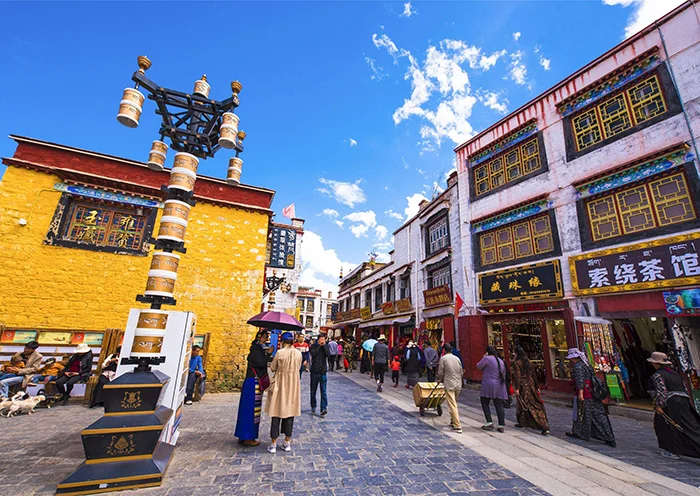
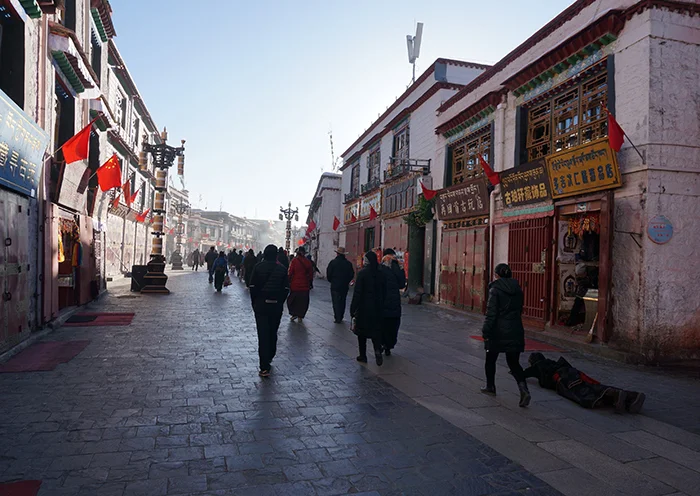
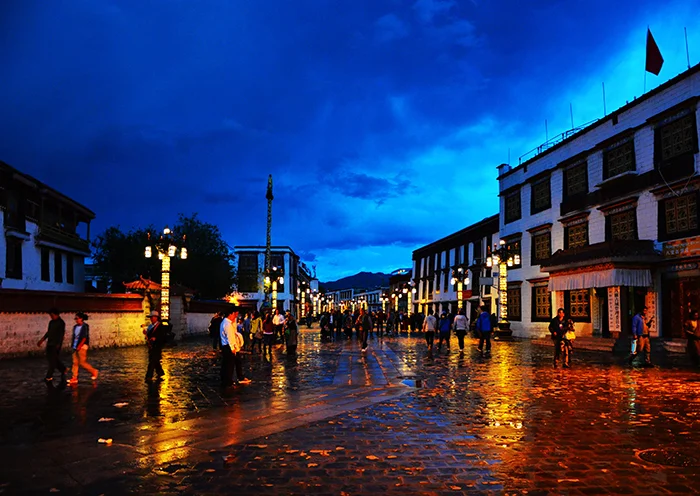
The day concludes with a stroll through Barkhor Street, the ancient kora (pilgrim circuit) surrounding the Jokhang. Today, it is a vibrant marketplace where ancient traditions meet modern life. You can join the locals in their daily walk, sip authentic yak butter tea at a local teahouse, or browse for unique Tibetan and Nepalese handicrafts.

Note on Logistics: The order of today’s visits may be adjusted based on your Jokhang Temple ticket reservation time. During the monk debates, please remain respectful and observe the monastery’s guidelines for visitors to ensure a peaceful experience for the practitioners.

iLocal Guide’s Tip:

“I always tell my guests to take a moment and just sit by the Jokhang entrance. Watching the sunlight hit the golden roof while locals perform their prostrations is a powerful experience that no photo can truly capture. If you want the best local vibe, try the sweet tea at a hidden teahouse in the back alleys of Barkhor-it’s where the real Lhasa happens.”

Altitude: 3650m

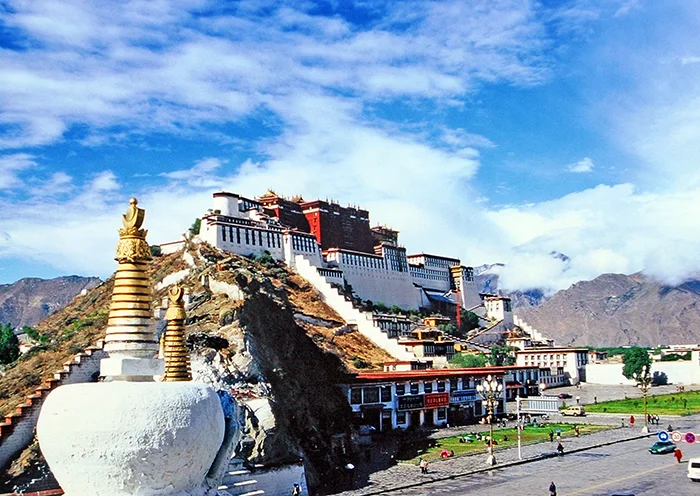
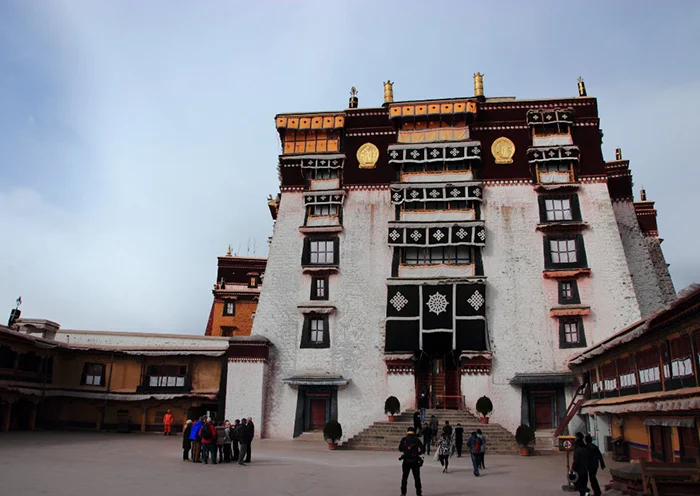
Start your morning at the Potala Palace, the iconic winter residence of the Dalai Lamas and a UNESCO World Heritage site. You will ascend 365 steps to reach the Red Palace at an altitude of 3,700m. Inside, you’ll find jeweled stupas and ancient murals that date back to the 7th-century reign of King Songtsen Gampo.

You will join local pilgrims who travel from across the plateau to this sacred site. Please note that photography is prohibited inside the chapels, and visits are strictly limited to one hour. Your guide will manage all the ticket logistics to ensure a smooth entry despite the high demand for this historic landmark.

Next, we explore Drepung Monastery, once the largest monastic university in Tibet. This was the primary seat of power before the Potala was expanded in the 17th century. It remains famous for its dramatic monk debates and the annual Shoton (Yogurt) Festival, where massive Buddha tapestries are unfolded across the hillside.

End the day with an immersive 2-hour cultural workshop. You’ll try your hand at Tibetan incense making and traditional block printing. These hands-on activities offer a deeper connection to local heritage than a standard sightseeing stop, allowing you to create your own authentic souvenirs.

iA Note from Your Travel Consultant:

“I’ve guided countless travelers through the Potala, and I always remind them to watch the quiet devotion of the pilgrims rather than just the gold. I love our Drepung workshop-it’s where I see my guests stop being ‘tourists’ and start feeling the rhythm of Tibetan life through their own hands. It’s the part of the day I personally look forward to most.”

Altitude: 3850m | Distance: 380km, about 7 hours’ drive

Today’s 8 to 9-hour journey takes you 340km across the heart of the plateau. After a morning drive, we reach the Kampala Pass (4,797m), the perfect vantage point for Yamdrok Lake. This sacred, turquoise lake stretches toward the horizon, framed by the towering Mt. Nyenchen Khangsar.

At the lakeside, you’ll see local herders with decorated Tibetan mastiffs and yaks. These animals are a vital part of local life. If you’d like a photo, it’s customary to pay 5-10 RMB, which directly supports the local families. After soaking in the views, we continue toward the glaciers.

Next, we visit the massive Karola Glacier, which sits at 5,012m just steps from the highway. Famous as a filming site for “Red Valley,” the ice looks like a massive frozen waterfall cascading from the peaks. You can easily walk to the base for a closer look at the ice and the neighboring Mt. Kalurong.

Essential Tips for the Glacier: Since the altitude here exceeds 5,000m, please move slowly to avoid altitude sickness. The public facilities at this remote spot are very basic, so we recommend using the restrooms before arrival. Also, always ask for permission before photographing locals to ensure a smooth experience.

The day ends in Shigatse, the gateway to the Friendship Highway and Everest. We’ll settle into our hotel to rest and acclimatize for the higher altitudes ahead. Tomorrow, we head for the ultimate destination – Everest Base Camp.

Expert Insight: A Local’s Perspective

“I’ve driven this route hundreds of times, and the color of Yamdrok Lake never looks the same twice; it shifts from turquoise to sapphire depending on the light. I always tell my guests to take the ‘basic’ facilities at the glacier in stride – it’s all part of the raw, high-altitude adventure that makes reaching Everest tomorrow feel so much more rewarding.”

iNotes for visiting Karola Glacier:
  1. The altitude at the glacier scenic spot is about 5,012m, so be sure to slow down to avoid altitude sickness.
  2. The public toilet at the glacier is very basic.
  3. Local people may ask you to take photos with them for a fee. Be sure to ask before taking photos to avoid potential issues.

After that, drive about 3.5 hours (170km) to your hotel in Shigatse, the nearest town on the Friendship Highway between Tibet and Nepal. Have a good rest and get ready for a once-in-a-lifetime trip to EBC the next day.

Altitude: 5100m | Distance: 340km, about 6.5 hours drive

Morning: Drive to Gyawu La Pass

After breakfast, you leave Shigatse and head toward the roof of the world. The road stretches west, climbing slowly through wide valleys and small Tibetan villages. Tonight you’ll stay at Everest Base Camp-a simple lodge at 5,100 meters, with Everest towering above.

About 4.5 hours into the drive (240km), you’ll reach Gyawu La Pass at 5,200 meters. This is your first real view of Mount Everest. The mountain rises in the distance, dwarfing everything around it. Below you, the road curves in endless switchbacks-a favorite shot for photographers. You might spot cyclists or pilgrims making their way toward the mountain. For Tibetans, reaching Everest’s base is a sacred journey.

Stop here. Breathe. Let the scale of it sink in.

Afternoon: Rongbuk Monastery

From the pass, it’s another 3.5 hours (122km) to Rongbuk Monastery, the highest-altitude monastery in the world at 5,154 meters. The road follows valleys carved by ancient glaciers, with Everest growing larger by the minute.

Rongbuk isn’t just a monastery-it’s a place of meditation. For over 400 years, hermits have sat in caves dotting the cliffs around the valley. You’ll see white chortens, mani stone piles, and prayer flags stretched across the rocky slopes. Monks and pilgrims move slowly in the thin air.

This is also your best view of Everest before reaching Base Camp. The north face rises directly behind the monastery, close enough to touch (though it’s still 20km away). Take your time here. Walk the grounds. Light incense. Watch the light change on the mountain.

Evening: Everest Base Camp

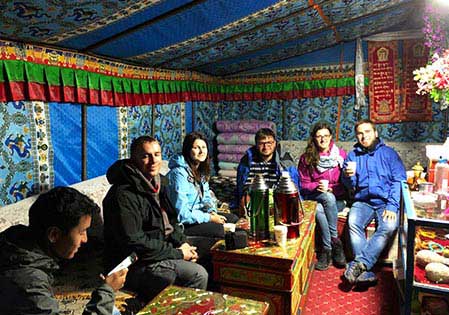
A short drive brings you to Everest Base Camp. Tonight you’ll stay in basic lodges-simple beds, shared facilities, and a warm dining tent where the group gathers for dinner. Expect a hot pot meal, hearty and welcome after the long drive.

The air is thin at 5,100 meters. Move slowly. Drink water. If the sky clears, step outside before bed. The stars over Everest are unlike anywhere else.

iNotes:
  1. Travelers can only go as far as the Rongbuk Monastery area now, not the original Base Camp a few kilometers farther. For viewing Everest, the difference is minimal.
  2. Food and lodging at EBC are very basic. This is part of the experience. Altitude sickness is possible-stay hydrated, rest when needed, and don’t push yourself. Your guide will check on everyone.

Altitude: 2800m | Distance: 370km, about 8 hours’ drive

Watching the sunrise over Mt. Everest is a popular activity, you can choose to wake up early in the morning and hike to a nearby vantage point to witness this breathtaking and unforgettable sight.The sunrise over Mt. Everest is not only a beautiful natural phenomenon but also a symbol of human achievement and perseverance. (Note: The sunrise usually starts around 6:30 am to 7am)

After having breakfast at EBC, it will be the time to drive from Rongbuk Monastery to Gyirong Town.

During the drive, you will make a stop at the Gyawu La Pass (5,200m) to catch another glimpse of Mount Everest. When the weather is clear, you will be able to see four mountains that are above 8,000m (Makalu, Lhotse, Everest, and Cho-Oyu). Apart from Mount Everest, you will be amazed by the zigzag road that looks as though it winds to the end of the world.

You will then head to Gyirong Town, where the Gyirong Port is located, via part of the Friendship Highway, also known as the China-Nepal Highway. Overnight in Gyirong/Kyirong.

iTravel Note:

1.When we talk about Everest Base Camp (EBC), we are referring to the area near Rongbuk Monastery that ordinary travelers are allowed to visit. EBC is about 20km from Mount Everest’s summit as the crow flies. From EBC, travelers can view the summit of Mount Everest in fine weather.

2.The Friendship Highway is an 800-kilometre scenic route that connects Lhasa, the capital of Tibet, to the Chinese/Nepalese border at the Sino-Nepal Friendship Bridge between Zhangmu and Kodari. (Note: Currently, the Zhangmu Port is primarily used for freight, while Gyirong Port is used for tourism.)

It is time to end your 10-day Chengdu-Tibet-Nepal Overland Tour. Our team will say goodbye to you at Gyirong/Kyirong border between Tibet and Nepal in the morning, and you will continue on your next destination in Nepal. 

iNote:

If you require assistance for your tour in Nepal, such as a Nepal guide and vehicle to pick you up and transfer you from the border to Kathmandu, please do not hesitate to contact us.

Thank you for choosing Tibet Daily for your Tibet tour, and we are always here working for you and hope to see you again for your next trip to China/Asia. Safe journey!

Make an inquiry

Free inquiry. No payment required. We reply within 24h.

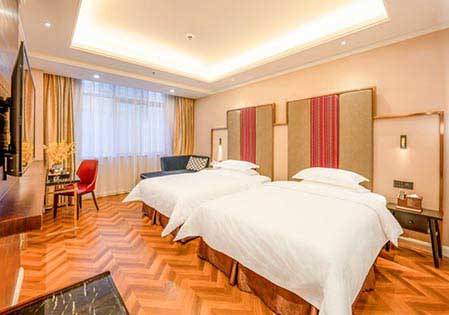
Accommodation & Hotel Condition for Your Tibet Tour

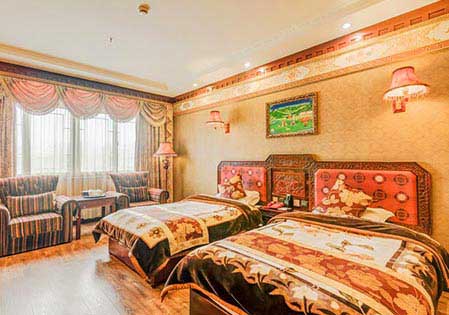
Have a good sleep everyday is very important during your China tour. In a private tour, you can decide on your own which hotel class you want – luxury 5 starcomfortable 4-star or economic 3-star.
All the hotels in each destination we selected are at good location, close to commercial street or tourist attractions. And, all the hotels we use have a business relationship for many years and they have windows, air-conditioners, hot water, showers, wifi… (except for basic accommodation condition when travel to Mount Everest) to ensure you luxury and comfortable sleep experience. The staff can speak English and they will provide you the high quality service. If you have any requirements, you can ask them to help.
What’s Included & What’s Not Included

•  The price is based on a group tour for 2 people sharing one standard double-bed room in comfort hotels.
•  Price varies depending on travel date, group size, hotel class, program in your itinerary and possible fluctuation of currency exchange rate.

What’s Included

Transportation
•  Regular licensed tourist vehicles (7–26 seats).
•  If there are fewer than 4 travelers for Lhasa city sightseeing, your guide will accompany you by taxi, and the taxi fare will be covered by the travel agency.
•  This is a join-in group tour, so changes of vehicles or guides may occur. Thank you for your understanding.
•  Due to Tibet’s limited tourism infrastructure, vehicles are generally older than those in mainland cities.
•  Most vehicles do not use air conditioning, as high altitude and temperature differences can cause mechanical issues and increase the risk of catching a cold.
•  There are driving speed limits in certain regions of Tibet (e.g., specific sections must not be completed in less than two hours). Your driver may stop at random points for rest or waiting—please be patient and enjoy the scenery.
•  When joining a group, pickups may involve waiting while collecting guests from multiple hotels. Please be punctual; if you voluntarily give up any day’s travel, the vehicle fee cannot be refunded.
•  Luggage policy: To ensure safety and comfort at high altitude, each traveler may bring one 26-inch suitcase and one small backpack. The guide will assist in storing excess luggage at your Lhasa hotel if necessary.

Accommodation
•  Standard twin rooms in basic hotels (double occupancy). Single-bed rooms (king-size) are not guaranteed; no extra bed or breakfast is provided for travelers not occupying a bed.
•  In case of odd-numbered travelers, the agency may arrange triple rooms, room-sharing, or charge a single supplement.
Fixed hotels are pre-arranged for group tours; specific hotel requests cannot be accepted.

Meals
•  Daily hotel breakfasts included.
•  Onecomplimentary local specialty meals (non-refundable if not used):
Lhasa Specialty Meal (Tibetan or Nepalese cuisine)
Other meals are self-arranged. If you are unaccustomed to Tibetan food, you may bring your own side dishes.
•  Complimentary meals may be arranged as lunch or dinner.

Guide Service
•  Chinese-speaking, English-speaking, or bilingual (Chinese-English) guides.
Guides are arranged according to the group composition. If both Chinese and English speakers are in one group, a bilingual guide will be provided.
•  In shared group tours, guide or vehicle changes may occur – your understanding is appreciated.

What’s Not Included

Single Room Supplement
•  Tour prices are based on twin-room occupancy (except for dormitory-style rooms).
•  If you require a single room, an additional single supplement fee will apply.

Hotel Changes or Hotel Cancellation Loss
•  Since hotels are prepaid in full, no refunds will be issued for any unused nights or itinerary changes after check-in.
•  Any damage to hotel property or extra charges incurred will be the traveler’s own responsibility.

Personal Expenses
•  All personal expenses are not included, such as:
Laundry, telephone, fax, or pay TV
Drinks, snacks, tobacco, or alcohol
Any other items or services of a personal nature

Unforeseen Circumstances
•  In case of force majeure or events beyond the control of the travel agency (such as natural disasters, war, strikes, epidemics, flight delays or cancellations, or insufficient group size),the agency reserves the right to cancel or adjust the itinerary.
•  Any extra costs incurred as a result will be borne by the traveler.

Transportation to and from Tibet
•  The tour price does not include flights or train tickets to and from Tibet. If you would like the travel agency to assist with booking, additional costs will apply.

Cancellation Policy

In the event that you need to cancel your trip, please ensure that you submit a written cancellation request. The calculation of cancellation fees will begin from the date we receive your written request.
The cancellation fees will be calculated as follows:

• If the cancellation is made between 45 and 30 days before the scheduled departure date, a fee of 10% of the full payment per person will apply.

• If the cancellation is made between 29 and 15 days before the scheduled departure date, a fee of 30% of the full payment per person will apply.

• If the cancellation is made between 14 and 7 days before the scheduled departure date, a fee of 50% of the full payment per person will apply.

• If the cancellation is made between 6 and 0 days before the scheduled departure date, a fee of 100% of the full payment per person will apply.

Important Trip Notes

All foreign travelers are required to obtain a Tibet Travel Permit to visit Tibet. The permit can only be applied for through a registered travel agency in Tibet (we are local based Tibet travel agency with office setting in Lhasa) and is required to purchase flight or train tickets to Tibet. The permit is necessary to enter Tibet and visit certain areas within the region, including Lhasa and Mount Everest Base Camp. Travelers should plan ahead and allow sufficient time for the permit application process, as it can take one to two weeks to obtain the necessary permits.
All foreign travelers are advised to make their bookings at least one week in advance and send the necessary documents to us for obtaining the permits. However, if you plan to visit Mount Kailash, it is recommended to book at least two weeks in advance, as it may take longer to obtain the necessary permits.

Typically, small group tours in Tibet will have 1-16 travelers, and you will have the opportunity to meet and travel with tourists from different parts of the world. This can be a great chance to make new friends and connect with people from different cultures and backgrounds.

Yes, if you are traveling with a group of friends or with your family, you can customize your own group tour. Please contact your professional travel consultant to discuss and arrange a customized group tour that meets your needs and preferences.

 
•  “B” stands for breakfast. You will have it at your hotel in the morning.
 
•  “L” stands for lunch. The restaurants we will arrange for you are all designated tourist restaurants approved by local tourist administration bureau. All are in good sanitary conditions. Lunches are usually included if you have a full day tour in one destination. Your guide will assist you with ordering the dishes. If you will travel from one city to another, lunches are excluded and you can ask the guide for some suggestions about where and what to eat.
 
•  “D” means dinner. All dinners are excluded in the itinerary. You have the chance to taste some authentic Chinese food and local snacks.
 
•  If you have special dietary requirements (vegetarian, halal, kosher, Indian, or gluten-free), please let us know before your booking. We will try our best to take care of you.

Book Your Expert-Led Tibet Discovery

Ready to see Tibet differently? Join our specialized local team for an authentic, high-altitude experience designed to go far beyond the typical tourist route. With vetted logistics, expert local guides, and a passion for deep cultural immersion, we guarantee a journey that is as safe as it is transformative. Secure your spot today—your path to the heart of Tibet starts here.

Expert-Guided Cultural Deep-Dive

Not just tours, but true immersion. Unlike generic sightseeing, our routes are crafted by local scholars and Himalayan experts. You aren’t just visiting landscapes; you are entering stories, gaining insights into Tibetan history, Buddhism, and plateau life that remain invisible to the standard traveler.

Authentic & Transparent Journey

Zero commercial pressure. We believe your pilgrimage belongs to you alone. We strictly adhere to a 100% No Shopping Stops policy, ensuring every moment of your precious time is spent exploring sacred heritage and breathtaking nature—never in a commercial trap.

Perfectly Paced Exploration

Slow travel in high-altitude comfort. We prioritize both your safety and your experience. Our itineraries are masterfully paced for high-altitude acclimatization, blending iconic ‘big wow’ landmarks with secret, hidden gems, allowing you to breathe in the plateau’s serenity without ever feeling rushed.