Home / Tours / Tibet Group Tours

16 Days Lhasa Mt.Everest Mt.Kailash Guge Kingdom: Mysterious Tibet Group Tour

  • TD-TGT-F1
  • 16 Days
  • Tibet Group Tours

Expedition Overview

Prefer cheap Tibet tour with Mount Kailash and Mount Everest in one trip? Take 16-day Tibet Group Tour to Lhasa, Yamdrok Lake, Shigatse, EBC, Mount Kailash (3-day Trekking) at best price in small group. 2-16 travelers, 4-star hotel, stable departure.

Lowest Price Guarantee. Reserve Now and Pay Later.

What kind of journey can both open your eyes and enlighten your spirit? Tibet, located in southwestern China, is a land of mystery and profound beauty, where ancient traditions, sacred rituals, and dramatic landscapes blend seamlessly. From hidden monasteries to snow-capped holy mountains, Tibet offers travelers a rare glimpse into a world that is both enchanting and deeply spiritual.

We, local based in Tibet, offer you 16-day Tibet group tour, the most popular trip. You’ll explore all essence on the plateau: Lhasa and its surroundings, Yamdrok Lake, Karola Glacier, Shigatse, Everest Base Camp, Mount Kailash, ancient Guge Kingdom.

Standing before Mount Everest – the highest peak on earth – is an awe-inspiring moment, allowing you to witness its majesty from the best viewing point. Meanwhile, the 3-day Mount Kailash trek is both challenging and rewarding, offering devoted pilgrims and adventurous travelers alike the chance to complete the sacred kora and experience spiritual renewal. (Good news! 2026 is the Year of the Horse – a perfect time to do the kora and receive more blessings.)

Beyond holy mountains, you will be captivated by Tibet’s emerald lakes, each with unique shapes, colors, and legends. The mysterious Guge Kingdom, once a flourishing civilization in western Tibet from the 10th to 17th centuries, is another highlight. Its cliff-top ruins, monasteries, and murals echo the grandeur of an ancient empire and reveal the region’s rich cultural heritage.

Join us now. It will be small group, 4-star accommodation, seamless arrangement, professional local guide and driver. Best price we offer and you can compare!

Tour Notice (Days 13-16, two plans): The itinerary offers two options depending on whether travelers exit Tibet via the Gyirong Border. Please refer to the detailed Day 13–14 arrangements in the day-by-day itinerary.

Itinerary

Tashi Delek! Welcome to Lhasa, the capital of the Tibet Autonomous Region! Upon arrival at Lhasa Gonggar International Airport or Lhasa Railway Station, our friendly Tibetan guide will greet you with a Hada (a traditional white silk scarf) and warm blessings. (Tip: Please let us know your mode of transportation and arrival time in advance.)

After that, our guide and driver will escort you to your hotel in downtown Lhasa. (Tip: The airport is located about 60 km southeast of the city, 1-1.5 hours’ drive.)

After check-in, take the rest of the day to relax and acclimatize to Lhasa’s high altitude (3,650 m). It’s important to allow your body to adjust before beginning your exciting journey through Tibet.

Helpful Reminders for Your First Day in Lhasa

  • Take a good rest and stay calm.This is the best way to prevent altitude sickness.
  • Avoid strenuous activity and you’d betternot take a shower on the first night to prevent catching a cold.
  • Do not drink alcohol.Instead, drink plenty of water, eat fruits, and avoid heavy meals.
  • If you wish, you can prepare herbal or oxygen supplements such as Rhodiola, American ginseng lozenges, or Gaoyuan’anto help with adaptation.
  • Always follow the advice of your local guide. If you feel unwell, inform your guide and seek medical attention promptly.

Today, enjoy hands-on cultural experience at the Lhasa Traditional Handicraft Art Center and gain deeper insight into Tibetan Buddhism by witnessing the monks’ debating session at Sera Monastery.

In the morning, immerse yourself in traditional Tibetan arts at the Lhasa Traditional Handicraft Art Center. Take part in making Tibetan incense, practicing Tibetan calligraphy, and learning the secrets of traditional woodblock printing.

Tibetan incense is commonly burned as an offering during Buddhist ceremonies and rituals. Its ingredients often include juniper, sandalwood, cedarwood, cinnamon, cloves, and a variety of medicinal herbs.

In addition to crafting incense, you can observe the full process demonstrated by the local artisan, who will teach you Tibetan calligraphy and help you write your own name or blessing in the Tibetan script. This makes for a meaningful keepsake to bring home as a memory.

In the afternoon, take a short drive of about 7 km (20 minutes) to visit Sera Monastery, one of the three great Gelug university monasteries in Tibet. Here, you’ll experience Tibetan Buddhism up close.

The highlight is the monks’ debate, held daily from around 15:00 to 17:00 (except Sundays). This lively intellectual exchange involves one monk standing and asking questions, while others sit and respond. The standing monk’s gestures – such as palm-slapping and foot-stomping – symbolize activating wisdom and are not acts of aggression. You’ll also have the chance to observe prayer ceremonies, explore meditation halls, and learn about monastic life.

After the tour, be transferred back to your hotel in Lhasa.

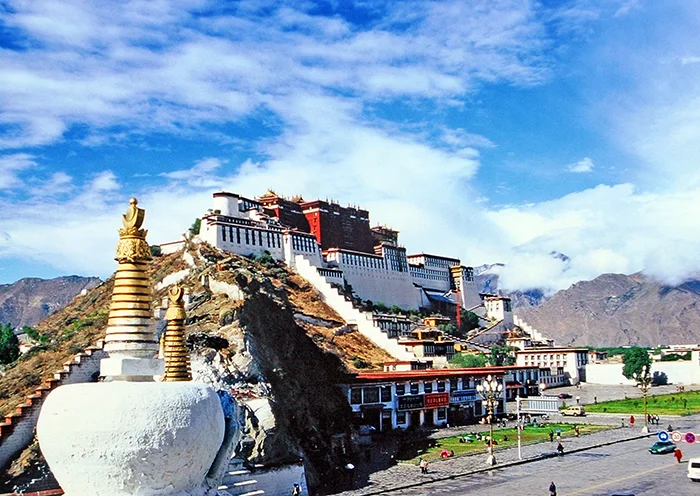
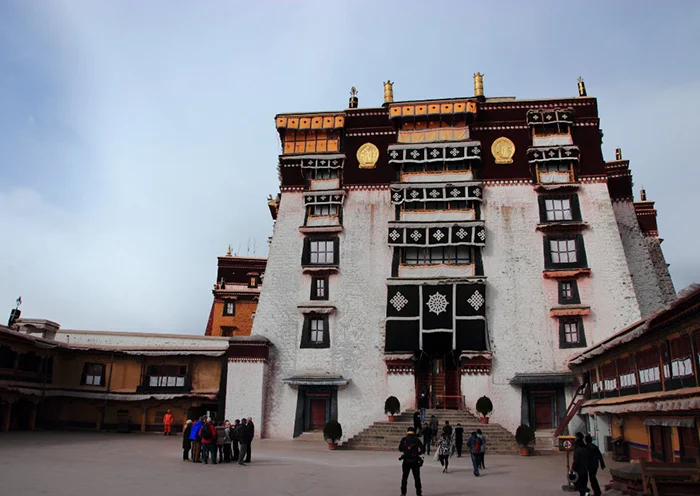
Today, it is the time to explore Lhasa by visiting the world-famous Potala Palace, a World Heritage site and the picture behind the 50 RMB. And then, you will explore Lhasa by visiting Jokhang Temple, a world cultural heritage site renowned for its brilliant architecture, culture, art, and history. Finally, you can stroll through the famous Barkhor Street with locals and learn more about the daily kora life of Tibetans.

This morning, you’ll first explore Potala Palace. This is the most iconic landmark of Tibet and the former winter residence of the Dalai Lamas (1649-1959).

After climbing 365 stone steps from the palace gate to the Red Palace, you’ll reach the highest ancient palace in the world – standing proudly at 3,700 meters above sea level – and enjoy stunning panoramic view of Lhasa city.

As you wander through the halls, chapels, and sacred shrines that honor past Dalai Lamas, you’ll be captivated by the intricate murals, exquisite carvings, dazzling jeweled decorations, and the deep spiritual atmosphere that fills the air. Inside the Potala Palace, countless Tibetan pilgrims can be seen bowing and praying devoutly – for many, visiting this sacred site is the journey of a lifetime.

Your guide will also share fascinating stories about King Songtsen Gampo, the 33rd ruler of Tibet, who originally built the Potala Palace in the 7th century to honor his marriage to Princess Wencheng of the Tang Dynasty.

Potala Palace Visiting Tips:

  • All visitors must enter as part of a guided group and can stay inside for a maximum of one hour.
  • Tickets are issued under a real-name reservation system. A valid ID or passport is required, and once reserved, rebooking is not allowed within 7 days.
  • Entry times are assigned randomly by the Potala Palace Administration, and it’s not possible to choose your visiting hour.
  • During peak season, your travel group may be split into smaller sub-groupswith different visiting times or guides.
  • Photography is strictly prohibitedinside the palace.

Next, your group will visit Jokhang Temple, the spiritual heart of Lhasa with a history of more than 1,300 years. From afar, you’ll see countless devoted pilgrims prostrating in front of the temple. Stop for a while to witness this moving sight and the unwavering faith of Tibetan Buddhists. This will be a moment to touch your soul.

According to legend, Jokhang Temple was built by King Songtsen Gampo for his two brides – Princess Wencheng of China and Princess Bhrikuti of Nepal. The name Jokhang means “House of the Buddha,” and the temple enshrines a life-sized statue of the 12-year-old Sakyamuni, one of the most sacred treasures in the Buddhist world. This makes Jokhang Temple the holiest pilgrimage site in Tibet.

Take time to explore the temple’s intricate architecture – admire the colorful murals, ornate decorations, and fine carvings that showcase the essence of Tibetan craftsmanship. From the second floor, you can enjoy a panoramic view of the bustling Barkhor Street below.

Visiting Tips for Jokhang Temple:

  • Visiting time: about 1 hour.
  • Admission requires real-name reservation through the “Jokhang Temple Reservation” WeChat between 7:00–23:59 for the next day. Reservations are limited, so please book in advance with your guide’s assistance.
  • Jokhang Temple is an active religious site. During important religious ceremonies or special events, access may be restricted -your understanding is appreciated.

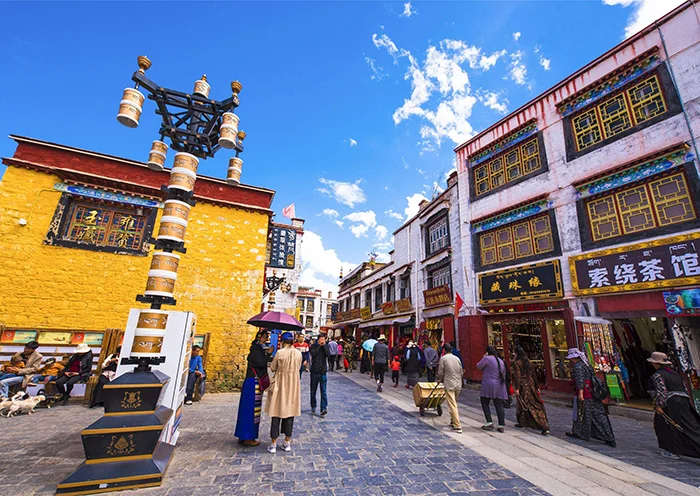
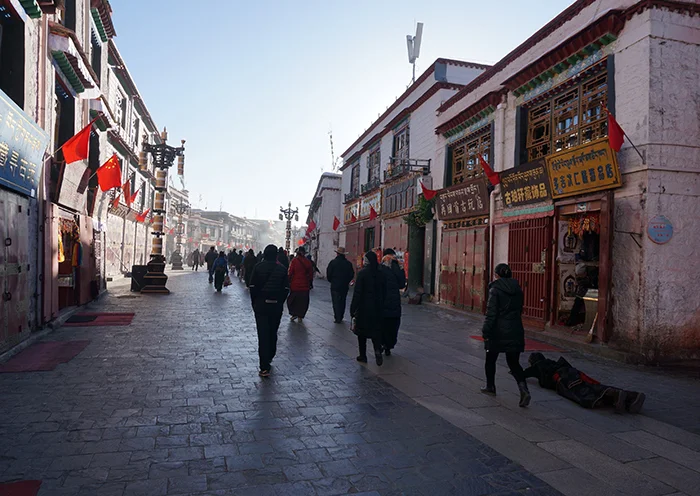
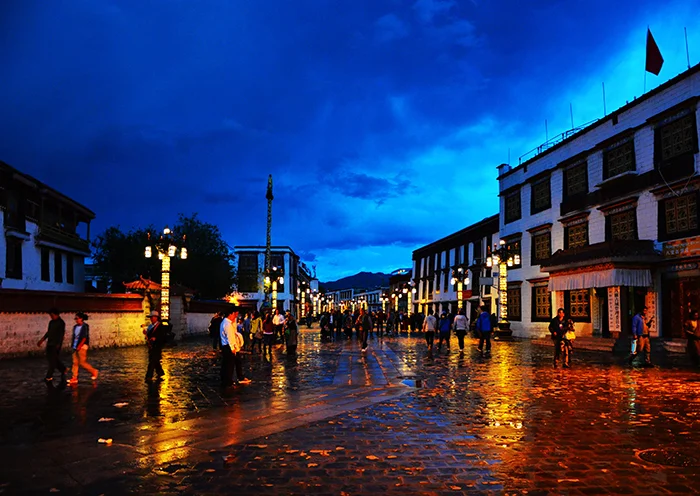
After the visit, step outside to Barkhor Street, once the traditional kora (pilgrimage circuit) around the temple. Today, it’s a lively place filled with the scent of incense and the sounds of chanting pilgrims. You can sip yak butter tea at a teahouse, dress in Tibetan attire for photos, or shop for unique handicrafts and souvenirs from Tibet, Nepal, and India.

After the tour, be escorted back to your hotel in Lhasa.

Today, you’ll embark on a scenic drive from Lhasa to Shigatse, Tibet’s second-largest city. The journey covers around 370 kilometers and takes 7 hours’ drive, with stops to admire two of Tibet’s most spectacular natural wonders – Yamdrok Lake and Karola Glacier.

In the morning, after about 2-3 hours of driving (110 km), get your camera ready as you approach Kampala Pass (4,797 m). Here, you’ll be rewarded with a breathtaking panoramic view of Yamdrok Lake, a turquoise ribbon shimmering among snow-capped mountains. Known as one of Tibet’s four sacred lakes (along with Lhamo Latso, Manasarovar, and Namtso), Yamdrok is believed to hold spiritual power – helping Tibetans locate the reincarnated soul of the Dalai Lama. You’ll also see locals offering photo opportunities with Tibetan mastiffs, yaks, or goats dressed in traditional ornaments.

Specially Arranged Meal at Yamdrok Lake by TD:
Take a break at Yamdrok Lake to enjoy special Hot Pot arranged by Asia Odyssey Travel. Fresh dish, stunning lake views, totally get relaxed. Also have time to take beautiful photos before or after your meal.

In the afternoon, continue driving for about 1.5 hours (87 km) to reach the stunning Karola Glacier (5,012 m) – one of Tibet’s three major continental glaciers and a filming site of the movie Red Valley (Hong He Gu). Backed by Naiqin Kangsang Peak (7,191 m), the glacier gleams like a frozen waterfall cascading right beside the highway. You can enjoy the view from your vehicle or take a short, easy walk to the glacier’s base. Across the road, admire the majestic snow-capped Mount Kalurong – another highlight of this alpine wonderland.

Tips for visiting Karola Glacier:

  • The alitude here is about 5,012 meters, so move slowly and avoid overexertion.
  • The public toilets are very basic -be prepared.
  • Some locals may charge a small fee for taking photos with them or their animals -always confirm before photographing.

Next, we head to Gyantse to explore the Pelkor Chode Monastery. The highlight here is the spectacular Gyantse Kumbum. As you explore this 32-meter-high stupa, you’ll be amazed by the exquisite carvings, sculptures, and murals that decorate its many levels and chapels.

Afterward, drive from Gyantse county, along the wide Nianchu River Valley, passing through scenic Tibetan villages, vast barley fields, and golden rapeseed flower fields (in summer). Upon arrival in Shigatse (altitude: 3845 meters), check into your hotel and have a good rest.

Warm Reminder:

For foreign and Taiwan travelers, registration at the Shigatse Entry & Exit Administration Office is required. Your guide will assist with the process and may adjust the schedule accordingly – please follow their instructions and cooperate as needed.

Today, your whole group will drive from Shigatse toward to Mount Everest (Qomolangma), the highest mountain on Earth. Along the way, admire the stunning transformation of the landscape as you ascend toward the Himalayas.

Gyawu La Pass – the Everest Viewing Platform

Follow the famous 108 switchbacks along the Everest Road to reach Gyawu La Pass (5210 m), also known as the Everest Viewing Platform. On clear days, this is one of the few places on Earth where you can see five of the world’s highest peaks above 8,000 meters lined up before you – Everest, Lhotse, Makalu, Cho Oyu, and Shishapangma. The panoramic view is awe-inspiring, with the mighty snow peaks stretching endlessly across the horizon.

Rongbuk Monastery – the Highest Monastery in the World

Continue to Rongbuk Monastery (5154 m), nestled at the foot of the Rongbuk Glacier. It is the highest monastery in the world, belonging to the Nyingma school of Tibetan Buddhism, and is home to both monks and nuns. The monastery is divided into old and new sections – the old one preserves meditation caves believed to have been used by Guru Padmasambhava, while the new section offers a spectacular view of Mount Everest’s north face. The white chorten and mani stones at the entrance make for iconic photo compositions – quiet, sacred, and timeless.

Everest Base Camp – Touching the Summit of the World

Standing at 8,848 meters, Mount Everest straddles the border between China and Nepal in the central Himalayas. The endless glaciers, hanging ice cliffs, and snow-covered ridges create a view of rare beauty and grandeur.

Then, head to Everest Base Camp (EBC, 5200 m) – the closest point ordinary travelers can get to the world’s highest peak. Surrounded by tented lodges, EBC stands just 19 km in a straight line from Mount Everest’s summit. Here, you can truly feel the majesty of the mountain – towering, powerful, and humbling. Many visitors describe this as a once-in-a-lifetime experience, with Everest’s sheer presence leaving an unforgettable impression.

Warm Tips for Visiting EBC:

  • FromEverest Town (50 km from EBC), travelers must transfer to the eco-friendly shuttle bus for the final stretch to Base Camp, and return the next day the same way. Your main driver and vehicle will not accompany you – please bring all essentials with you.
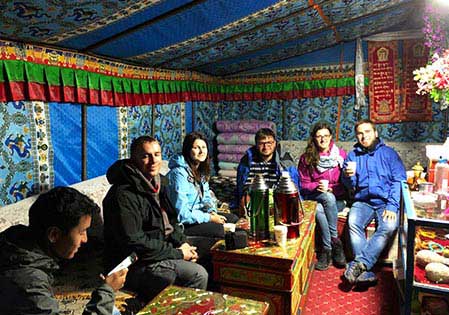
  • Accommodationat EBC is in tented camps (reconstructed in 2025) with improved facilities, now offering twin rooms and a simple dining tent. However, amenities remain basic with shared bathrooms. Supplies are limited due to high altitude, so please be understanding.
  • During winter, if the tent camp is closed due to weather, the group will stay in a guesthouse in Everest Town(or called Tashizom Town) (with private bathroom).
  • The altitude and temperature can be extreme -even in summer, nighttime temperatures may drop to 08°C. Please dress warmly or rent a down jacket at Base Camp if needed.

Wake up to the crisp morning air at Everest Base Camp and take a quiet moment to appreciate the majesty of Mount Everest and the surrounding Himalayas. If you wish, begin your day with gentle yoga or meditation to refresh your body and mind, or enjoy a peaceful walk around the base camp for closer views of this extraordinary landscape.

Tip: If weather permits, you can enjoy the Golden Summit view – one of the most breathtaking sights on Earth. The best seasons are spring (April–May) and autumn (September–November), when the skies are usually clear. You’ll need to rise early and take a short hike to the viewing point to see the snowcapped peaks glowing golden in the morning light.

After say goodbye to Mount Everest, your group will depart from Everest Base Camp and continue the journey toward Saga (or Zhongba) for today’s accommodation.

Along the way, you’ll have the chance to admire the majestic and awe-inspiring Mount Shishapangma, located about 120 km from Everest near the Nepal–Tibet border. Standing at 8,027 meters, it is the world’s 14th-highest mountain and the only 8,000-meter peak entirely within Tibet. Its towering ridges, massive glaciers, and the surrounding lush valleys and grasslands create truly spectacular scenery.

The route continues across the desolate plains of Digur Tang, where vast sand dunes contrast with the snow-covered peaks of Shishapangma and Langtang to the south. As you leave the Bum-chu Basin, you’ll descend toward the beautiful turquoise Pelkhu-tso (4,590 m), the largest lake in Shigatse. Revered as a holy lake, Pelkhu-tso shimmers like an emerald at the foot of sacred Mount Shishapangma, each enhancing the beauty of the other.

Travel Tip:

Due to limited accommodation options in this remote region, tonight’s stay may be arranged in either Saga or Zhongba.

After breakfast, your group continues the journey along the scenic G219 Highway. The landscapes along the way are endlessly captivating. You will pass the Maqu River Wetland before reaching Payang Town in Zhongba County, a small settlement full of western plateau charm and one of the highest towns in the world at an elevation of about 4,600 meters.

Farther ahead, you will encounter the sacred lake Manasarovar (4,588 m). Its crystal-clear waters mirror the silhouettes of Mount Kailash and Mount Naimonanyi. Revered by Tibetan Buddhism, Bon, and Hinduism, Manasarovar is honored as the “eternal and undefeated turquoise lake.”

As you continue, you will gradually enter the embrace of the holy mountain Mount Kailash, the main peak of the Gangdise Range, rising to 6,638 meters. Widely recognized as one of the world’s most sacred mountains, Kailash is considered the spiritual center of the universe by Hinduism, Tibetan Buddhism, Bon, and ancient Jainism. Although not the tallest peak in the region, it is the only one whose summit remains perpetually covered in snow, glowing mysteriously under sunlight. Its unique pyramid shape sets it apart from the surrounding mountains, inspiring profound reverence and awe. Facing Mount Naimonanyi across a distance of about 100 km, the two sacred peaks are flanked by the holy lakes Manasarovar and Rakshas Tal.

In the afternoon, arrive in Darchen (4,670 m), the starting point of the Mount Kailash Kora (pilgrimage circuit). Check in to your hotel and rest well as you prepare for tomorrow’s spiritual journey.

Mount Kailash, is a towering peak that rises to 6,638 meters and dominates the landscape of Western Tibet. Revered by four major religions – Tibetan Buddhism, Hinduism, Bon, and Jainism, this holy mountain is considered the spiritual center of the world. In Tibetan Buddhism, it is believed to be the abode of Demchok, the deity symbolizing supreme bliss. Each year, countless pilgrims make the arduous journey here to walk the 52-kilometer kora (circumambulation) around the sacred mountain, a deeply spiritual act believed to cleanse one’s sins and bring enlightenment.

Day One Trek: Darchen – Tarboche – Dira-puk Monastery

This morning, your group will take a short sightseeing bus ride from Darchen Town to Tarboche (Prayer Flag Square, 6km from the town). This is the official starting point of the kora and one of the most sacred ritual sites in Tibet. Every year during the Saga Dawa Festival (“Fourth Month” in the Tibetan calendar), hundreds of pilgrims gather here to raise the towering flagpole adorned with prayer flags, celebrating the birth, enlightenment, and death of Buddha Sakyamuni.

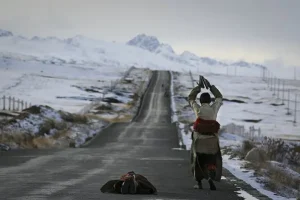
Now, begin your first day of trekking, following the Lha Chu River valley westward. The route is graced by blue skies, snow-capped peaks, and slopes dotted with mani stones engraved with sacred mantras. Along the way, you’ll see Tibetan pilgrims performing prostrations as they slowly make their way around the mountain – a moving testament to faith and devotion. This section is both physically demanding and spiritually rewarding, offering magnificent views of Mount Kailash’s western and northern faces.

As you venture deeper into the valley, the north face of Mount Kailash gradually reveals itself in full grandeur, an awe-inspiring sight that few places on Earth can rival. After trekking about 14 kilometers, you’ll arrive at Dira-puk Monastery, your destination for the day. This monastery, belonging to the Nyingma sect of Tibetan Buddhism, sits directly opposite the north face of Mount Kailash, providing an unparalleled view of the sacred mountain.

You will spend the night in a local guesthouse near Dira-puk Monastery.

Travel Notes:

  1. Local Tibetans around Mount Kailash offer optional services such as horse or yak rides, and luggage transportby yaks or porters (not included in the tour price).
  2. During the kora, accommodation is very basic, typically in shared guesthouses or tents at Dira-pukand Dzultripuk, with limited facilities (multi-bed rooms, shared toilets, one bed per traveler).

Start your trekking early in this morning. Today marks the most challenging and spiritually significant day of your Mount Kailash Kora. The trail leads you on a strenuous ascent of more than 550 meters to the sacred Drolma-la Pass (5,650m) – the highest point of the entire circuit.

This demanding section tests both body and spirit. According to Tibetan Buddhist belief, successfully crossing the Drolma-la Pass symbolizes the purification of one’s sins from a lifetime. Despite the thin air and rugged terrain, pilgrims consider this moment a deep act of faith and renewal.

At the summit, you’ll be greeted by a breathtaking sight – thousands of colorful prayer flags fluttering in the wind, blanketing the pass in a sea of sacred colors. Many pilgrims pause here to rest, pray, and add their own mani stones to the growing piles of devotion.

The descent that follows is steep and rocky, leading into the Lhachu Valley. Along the way lies the shimmering Gauri Kund, a glacial lake revered in Hinduism as the bathing place of Parvati, the consort of Lord Shiva. Its jade-like waters glisten serenely beneath the towering peaks.

After a short rest, continue your trek for another four hours along the riverbank until you reach Zutul-Puk Monastery (4,810m), known as the “Miracle Cave of Milarepa.” This sacred monastery, belonging to the Sakya sect, holds ancient murals, scriptures, and legends of the great yogi Milarepa.

Spend the evening resting at the guesthouse near Zutul-Puk. Have a good rest and prepare for the final leg of the Kora tomorrow.

Today marks the final leg of your Mount Kailash Kora – a day of completion and quiet reflection. After breakfast, you will leave Zutul-Puk Monastery, and begin a gentle descent as the altitude gradually lowers. The stark white of the high mountain snows slowly gives way to vibrant greens of grass and shrubs, signaling your return to the realm of life and movement.

Along the trail, you may spot small animals (like groundhogs) darting among the bushes, while countless mani stones – prayer-carved rocks stacked in colorful mounds – line your path like silent guardians, echoing the devotion of generations of pilgrims. The air feels lighter, and each step brings a sense of relief and fulfillment.

After walking the final 6.6 kilometers, you’ll reach Zongdui, where your Mount Kailash circuit officially comes to an end. Here, you can board the eco-sightseeing bus that will take you back to Darchen Town.

By midday, you’ll arrive in Darchen – tired yet deeply content – having completed one of the world’s most sacred pilgrimages. Yes, you did it! Great job!

In the afternoon, your journey continues toward Zanda, located in the heart of Ngari Prefecture. 230 kilometers, roughly 4.5 hours. As you leave Darchen behind, the rugged landscapes unfold into a mesmerizing panorama of eroded canyons, barren cliffs, and river valleys – a stark yet captivating portrait of Tibet’s remote western frontier.

Upon arrival in Zanda County (altitude: 4500 meters), you’ll find yourself surrounded by an otherworldly terrain carved by wind and water over centuries. This region is not only a geological wonder but also a cultural treasure, home to the legendary Guge Kingdom ruins and the ancient Tholing Monastery, both offering deep insight into Tibet’s forgotten civilizations.

Stay overnight in Zanda.

Today, your group will first enjoy Zanda County, delving into both its ancient history and dramatic landscapes. Begin with a fascinating visit to the Ruins of the Guge Kingdom, one of Tibet’s most mysterious archaeological sites. Flourishing between the 10th and 17th centuries, Guge was once a powerful kingdom that played a vital role in spreading Buddhism across western Tibet. The site features remarkable frescoes, sculptures, and carvings that vividly depict Buddhist teachings, royal life, and historical events. As you explore, you’ll visit the Red Palace, once a major religious center with temples and monks’ quarters, and the White Palace, the royal residence of the Guge kings. The blend of Tibetan, Indian, and Chinese architectural influences is evident in the intricate murals and carvings that still adorn the walls. From the top of the ruins, enjoy a sweeping panoramic view of the entire valley – a breathtaking reminder of the kingdom’s former glory.

Afterward, continue about 20 kilometers to the awe-inspiring Zanda Earth Forest, a geological masterpiece formed by centuries of wind and water erosion. Stretching for over five kilometers along the Elephant Spring River, this surreal landscape of natural sculptures resembles warriors, galloping horses, and meditating monks. The play of light and shadow across the ridges creates endless photo opportunities.

The final stop for today is Tholing Monastery, which dates back to the 10th century. As one of the oldest Buddhist monasteries in Tibet, it played a vital role in the spread of Buddhism and the flourishing of art during the era of the Guge Kingdom. The name “Tholing” means “hovering in the sky forever,” and the monastery is renowned for its well-preserved ancient frescoes and cultural treasures. During your visit, you will explore the Main Hall, home to a large statue of Buddha Shakyamuni; the Assembly Hall, used for important ceremonies and featuring a statue of Guru Rinpoche; and the Scripture Hall, where monks gather to study and recite Buddhist teachings.

After the visit, be transferred back to Darchen for overnight accommodation.

After breakfast, your journey continues as you travel from Darchen back toward Zhongba or Saga Town along the G219 National Highway.

Saga is located in the northwestern part of Shigatse Prefecture. The G219 Highway runs through the entire region – connecting eastward to Shigatse and Lhasa, westward to Ali and Burang, and southward toward Gyirong County and Nepal. Situated between the northern foothills of the Himalayas and the southern edge of the Gangdise Mountains, Saga lies along the upper reaches of the Yarlung Tsangpo River. The region offers expansive plateau scenery, including sacred mountains, holy lakes, vast grasslands, and herds of yaks. With an average elevation of over 4,600 meters, it features a typical high-altitude continental climate: cold, dry, with strong sunlight, thin air, long winters, and short summers.

Warm Tip:

Due to limited accommodation options for international travelers, tonight’s stay may be arranged in either Saga or Zhongba.

If there are NO travelers joining the F2 Route (13-day tour exiting via Gyirong Port), the itinerary for Days 13–14 will be as follows:

After breakfast, your group will continue the journey along the G219 National Highway. In the distance, the snow-capped peaks of the Longbukangri Range accompany you as you ascend the Tujila Mountain Pass, where colorful prayer flags flutter in the wind. The road gradually leads into the expansive Sangsang Grassland, where endless meadows stretch to the horizon like a green carpet. Herds of yaks dot the landscape like black pearls, while smoke rising from nomadic tents mingles with blooming wildflowers, creating a tranquil pastoral scene carried softly by the Tibetan breeze.

As you continue eastward, the altitude begins to drop, and you eventually arrive in Sakya. Here, the renowned Sakya South Monastery stands like a fortress-style mandala, its red walls and white eaves glowing under the evening sun. Inside, the magnificent “Wall of 80,000 Scriptures” and exquisite Yuan-dynasty murals gleam under soft light – a perfect cultural finale to a day of grand natural landscapes, earning Sakya its nickname “The Second Dunhuang.”

Stay overnight in Sakya.

Plan B: If there are travelers joining the F2 Route (13-day tour exiting via Gyirong Port), the itinerary for Days 13-14 will be arranged as follows:

After breakfast, your group will depart from Saga and continue toward the China–Nepal border.

Along the way, you will pass through Gyirong’s beautiful “back garden”, a region influenced by Nepali culture. Here, you’ll find charming local villages, stunning border-area scenery, snow-capped mountains, lush forests, deep gorges, and cascading waterfalls. The whole group will drive together into Gyirong Valley, where you’ll visit the gorge and its suspension bridge.

After the visit, travelers who need to exit China and enter Nepal will proceed directly to the Gyirong Border in the afternoon to complete border formalities and end their trip.

The rest of the group will stay overnight in Gyirong Town.

On this day, you will visit the renowned Sakya Monastery, a site of immense historical and cultural significance. Located in Sakya County, about 127 kilometers west of Shigatse, it is regarded as the original and most important monastery of the Sakya school, one of the four major schools of Tibetan Buddhism.

Founded in 1073, Sakya Monastery is not only a vital spiritual center but also part of the UNESCO World Heritage Site. It is famous for its distinctive fortress-style architecture, deep-rooted history, and extraordinary collection of Buddhist scriptures. As you explore the complex, you will walk through imposing walls, quiet courtyards, and beautifully decorated halls. Inside, you will find impressive statues, vibrant thangkas (Buddhist scroll paintings), ritual artifacts, and tens of thousands of ancient texts. A unique highlight is the Burde Gyaimalung, known as the largest book in the world. During your visit, you may observe the monks’ daily routines, witness prayer rituals, and gain a deeper understanding of monastic life in Tibet.

Afterward, continue your journey from Sakya to Shigatse. The drive is about 150 km and takes about 3 hours. Stay overnight in Shigatse.

Plan B: If there are travelers joining the F2 Route (13-day tour exiting via Gyirong Port), the itinerary for Days 13-14 will be arranged as follows: 

After breakfast, it is time to leave Gyirong Town and begin your exploration of Tibet.

After a long drive, your group will arrive in Sakya, where you will visit the renowned Sakya Monastery, a site of immense historical and cultural significance. Located in Sakya County, about 127 kilometers west of Shigatse, it is regarded as the original and most important monastery of the Sakya school, one of the four major schools of Tibetan Buddhism.

Founded in 1073, Sakya Monastery is not only a vital spiritual center but also part of the UNESCO World Heritage Site. It is famous for its distinctive fortress-style architecture, deep-rooted history, and extraordinary collection of Buddhist scriptures. As you explore the complex, you will walk through imposing walls, quiet courtyards, and beautifully decorated halls. Inside, you’ll find impressive statues, vibrant thangkas (Buddhist scroll paintings), ritual artifacts, and tens of thousands of ancient texts.

A unique highlight is the Burde Gyaimalung, known as the largest book in the world. During your visit, you may observe the monks’ daily routines, witness prayer rituals, and gain a deeper understanding of monastic life in Tibet.

Tonight, stay overnight in Sakya.

After breakfast, your group will drive from Sakya and make a stop in Shigatse. The distance between Sakya and Shigatse is about 150 km (about 3 hours’ drive). In Shigatse, visit Tashilhunpo Monastery, the spiritual heart of the city.

Founded in 1447 by Gyalwa Gedun Drup, the 1st Dalai Lama and a disciple of Tsongkhapa, Tashilhunpo Monastery is the largest monastery in Tibet’s Tsang region and one of the six great Gelug monasteries, alongside Drepung, Sera, Ganden, Labrang, and Ta’er. It has long been the traditional seat of the Panchen Lamas, the second-highest incarnation lineage in Tibetan Buddhism after the Dalai Lama.

At its height, the monastery housed more than 5,000 monks and included over 3,000 rooms, 50 affiliated temples, and 30 manors and pastures. Today, you can still feel its grandeur as you explore the vast complex of prayer halls, courtyards, and golden roofs glinting under the sun.

Highlights of Tashilhunpo Monastery:

  • Admirethe Maitreya (Future Buddha) Chapel, which enshrines a magnificent bronze statue of the Maitreya Buddha – made with over 115 tons of copper, 250 kg of gold, and adorned with more than 1,400 precious jewels, including diamonds and pearls.
  • Pay respectto the sacred stupas (reliquary chortens) of successive Panchen Lamas, exquisitely crafted with gold, silver, coral, pearls, turquoise, and silk.
  • Enjoya panoramic view of Shigatse City and the serene rhythm of monastic life, where monks in crimson robes chant sutras echoing through the halls.

After visiting Tashilhunpo Monastery, drive back to Lhasa along the scenic Friendship Highway, following the Yarlung Tsangpo River. The journey takes about 4.5–5 hours (270 km). Upon arrival, check into your hotel and relax for the night.

Overnight in Lhasa.

After breakfast, it’s time to say goodbye to the holy city of Lhasa. Your guide and driver will escort you to Lhasa Gonggar Airport or Lhasa Railway Station. Take your flight or train to next destination or go home.

Travel Tips:

  1. The drive from downtown Lhasa to the airport takes about 1 hour, so we recommend booking flights departing after 10:00 AM.
  2. Please share your flight or train schedulewith us in advance to ensure a smooth transfer.
  3. Kindly provide accurate flight or train booking detailsso that we can arrange the group’s complimentary shared transfer efficiently.

Thank you for choosing Asia Odyssey Travel for Tibet Group Tour. We hope to see you on your next journey!

Make an inquiry

Free inquiry. No payment required. We reply within 24h.

Accommodation & Hotel Condition for Your Tibet Tour

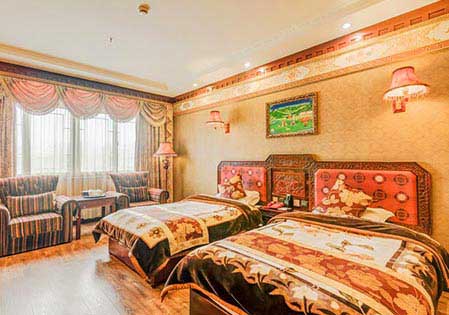
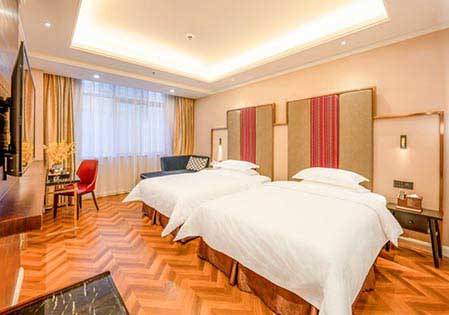
Have a good sleep everyday is very important during your China tour. In a private tour, you can decide on your own which hotel class you want – luxury 5 starcomfortable 4-star or economic 3-star.
All the hotels in each destination we selected are at good location, close to commercial street or tourist attractions. And, all the hotels we use have a business relationship for many years and they have windows, air-conditioners, hot water, showers, wifi… (except for basic accommodation condition when travel to Mount Everest) to ensure you luxury and comfortable sleep experience. The staff can speak English and they will provide you the high quality service. If you have any requirements, you can ask them to help.
What’s Included & What’s Not Included

•  The price is based on a group tour for 2 people sharing one standard double-bed room in comfort hotels.
•  Price varies depending on travel date, group size, hotel class, program in your itinerary and possible fluctuation of currency exchange rate.

What’s Included

Transportation
•  Regular licensed tourist vehicles (7–26 seats).
•  If there are fewer than 4 travelers for Lhasa city sightseeing, your guide will accompany you by taxi, and the taxi fare will be covered by the travel agency.
•  This is a join-in group tour, so changes of vehicles or guides may occur. Thank you for your understanding.
•  Due to Tibet’s limited tourism infrastructure, vehicles are generally older than those in mainland cities.
•  Most vehicles do not use air conditioning, as high altitude and temperature differences can cause mechanical issues and increase the risk of catching a cold.
•  There are driving speed limits in certain regions of Tibet (e.g., specific sections must not be completed in less than two hours). Your driver may stop at random points for rest or waiting—please be patient and enjoy the scenery.
•  When joining a group, pickups may involve waiting while collecting guests from multiple hotels. Please be punctual; if you voluntarily give up any day’s travel, the vehicle fee cannot be refunded.
•  Luggage policy: To ensure safety and comfort at high altitude, each traveler may bring one 26-inch suitcase and one small backpack. The guide will assist in storing excess luggage at your Lhasa hotel if necessary.

Accommodation
•  Standard twin rooms in basic hotels (double occupancy). Single-bed rooms (king-size) are not guaranteed; no extra bed or breakfast is provided for travelers not occupying a bed.
•  In case of odd-numbered travelers, the agency may arrange triple rooms, room-sharing, or charge a single supplement.
Fixed hotels are pre-arranged for group tours; specific hotel requests cannot be accepted.

Meals
•  Daily hotel breakfasts included.
•  Onecomplimentary local specialty meals (non-refundable if not used):
Lhasa Specialty Meal (Tibetan or Nepalese cuisine)
Other meals are self-arranged. If you are unaccustomed to Tibetan food, you may bring your own side dishes.
•  Complimentary meals may be arranged as lunch or dinner.

Guide Service
•  Chinese-speaking, English-speaking, or bilingual (Chinese-English) guides.
Guides are arranged according to the group composition. If both Chinese and English speakers are in one group, a bilingual guide will be provided.
•  In shared group tours, guide or vehicle changes may occur – your understanding is appreciated.

What’s Not Included

Single Room Supplement
•  Tour prices are based on twin-room occupancy (except for dormitory-style rooms).
•  If you require a single room, an additional single supplement fee will apply.

Hotel Changes or Hotel Cancellation Loss
•  Since hotels are prepaid in full, no refunds will be issued for any unused nights or itinerary changes after check-in.
•  Any damage to hotel property or extra charges incurred will be the traveler’s own responsibility.

Personal Expenses
•  All personal expenses are not included, such as:
Laundry, telephone, fax, or pay TV
Drinks, snacks, tobacco, or alcohol
Any other items or services of a personal nature

Unforeseen Circumstances
•  In case of force majeure or events beyond the control of the travel agency (such as natural disasters, war, strikes, epidemics, flight delays or cancellations, or insufficient group size),the agency reserves the right to cancel or adjust the itinerary.
•  Any extra costs incurred as a result will be borne by the traveler.

Transportation to and from Tibet
•  The tour price does not include flights or train tickets to and from Tibet. If you would like the travel agency to assist with booking, additional costs will apply.

Cancellation Policy

In the event that you need to cancel your trip, please ensure that you submit a written cancellation request. The calculation of cancellation fees will begin from the date we receive your written request.
The cancellation fees will be calculated as follows:

• If the cancellation is made between 45 and 30 days before the scheduled departure date, a fee of 10% of the full payment per person will apply.

• If the cancellation is made between 29 and 15 days before the scheduled departure date, a fee of 30% of the full payment per person will apply.

• If the cancellation is made between 14 and 7 days before the scheduled departure date, a fee of 50% of the full payment per person will apply.

• If the cancellation is made between 6 and 0 days before the scheduled departure date, a fee of 100% of the full payment per person will apply.

Important Trip Notes

All foreign travelers are required to obtain a Tibet Travel Permit to visit Tibet. The permit can only be applied for through a registered travel agency in Tibet (we are local based Tibet travel agency with office setting in Lhasa) and is required to purchase flight or train tickets to Tibet. The permit is necessary to enter Tibet and visit certain areas within the region, including Lhasa and Mount Everest Base Camp. Travelers should plan ahead and allow sufficient time for the permit application process, as it can take one to two weeks to obtain the necessary permits.
All foreign travelers are advised to make their bookings at least one week in advance and send the necessary documents to us for obtaining the permits. However, if you plan to visit Mount Kailash, it is recommended to book at least two weeks in advance, as it may take longer to obtain the necessary permits.

Typically, small group tours in Tibet will have 1-16 travelers, and you will have the opportunity to meet and travel with tourists from different parts of the world. This can be a great chance to make new friends and connect with people from different cultures and backgrounds.

Yes, if you are traveling with a group of friends or with your family, you can customize your own group tour. Please contact your professional travel consultant to discuss and arrange a customized group tour that meets your needs and preferences.

 
•  “B” stands for breakfast. You will have it at your hotel in the morning.
 
•  “L” stands for lunch. The restaurants we will arrange for you are all designated tourist restaurants approved by local tourist administration bureau. All are in good sanitary conditions. Lunches are usually included if you have a full day tour in one destination. Your guide will assist you with ordering the dishes. If you will travel from one city to another, lunches are excluded and you can ask the guide for some suggestions about where and what to eat.
 
•  “D” means dinner. All dinners are excluded in the itinerary. You have the chance to taste some authentic Chinese food and local snacks.
 
•  If you have special dietary requirements (vegetarian, halal, kosher, Indian, or gluten-free), please let us know before your booking. We will try our best to take care of you.

Book Your Expert-Led Tibet Discovery

Ready to see Tibet differently? Join our specialized local team for an authentic, high-altitude experience designed to go far beyond the typical tourist route. With vetted logistics, expert local guides, and a passion for deep cultural immersion, we guarantee a journey that is as safe as it is transformative. Secure your spot today—your path to the heart of Tibet starts here.

Expert-Guided Cultural Deep-Dive

Not just tours, but true immersion. Unlike generic sightseeing, our routes are crafted by local scholars and Himalayan experts. You aren’t just visiting landscapes; you are entering stories, gaining insights into Tibetan history, Buddhism, and plateau life that remain invisible to the standard traveler.

Authentic & Transparent Journey

Zero commercial pressure. We believe your pilgrimage belongs to you alone. We strictly adhere to a 100% No Shopping Stops policy, ensuring every moment of your precious time is spent exploring sacred heritage and breathtaking nature—never in a commercial trap.

Perfectly Paced Exploration

Slow travel in high-altitude comfort. We prioritize both your safety and your experience. Our itineraries are masterfully paced for high-altitude acclimatization, blending iconic ‘big wow’ landmarks with secret, hidden gems, allowing you to breathe in the plateau’s serenity without ever feeling rushed.