
One A4 sheet, one red seal, and every name on the trip
| Format | Printed A4, typically two pages |
|---|---|
| Page 1 | Approved route + travel dates |
| Page 2 | Group list: names, nationalities, passport numbers, occupations |
| Seal | Tibet Tourism Bureau red seal |
| Validity | Exact trip dates only |
| Original vs copy | Original required for flight and train boarding |
| Held by | You until boarding, then the guide |
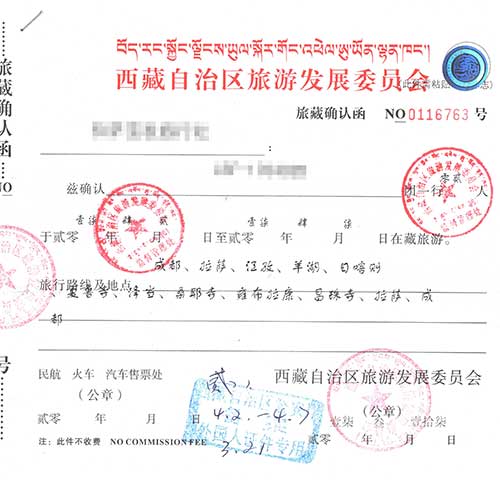
The Tibet Travel Permit is a printed A4 document — typically two pages — carrying the red seal of the Tibet Tourism Bureau. The first page sets out the approved route, town by town, with the travel dates; the second lists every traveller in the group with name, nationality, passport number and occupation, under the responsible agency and licensed guide. There is no card, no sticker in the passport, and no QR-code app version — the paper is the document, and the English line “No Commission Fee” printed on it confirms the Bureau charges nothing for issuing it.
Knowing what the sheets look like has a practical use: it lets you confirm that what your agency couriered is the real permit and not a booking confirmation dressed up as one.
The fields, annotated
| Field on the sheet | What it says | Why it matters at checkpoints |
|---|---|---|
| Permit number | The Bureau’s file reference | Quoted on any replacement request |
| Group list | Every traveller: name, passport number, nationality | Names are matched against passports at boarding; a renewed passport invalidates the line |
| Agency + guide | The registered Tibet agency and assigned licensed guide | The permit is legally theirs to carry once the trip starts |
| Approved route | Towns and counties, in order | Checkpoints compare your position against this list — an unlisted county is a turn-around |
| Validity dates | The exact trip window | No grace days on either side |
| TTB seal | Red official seal over the text | The visual mark airlines look for first |
Original or copy: where each works
Flights into Tibet — Lhasa Gonggar, Nyingchi Mainling, Shigatse Peace — require the original at check-in, and airlines apply this without exceptions. Train boarding historically ran looser, with emailed copies often accepted at Xining, but a March 2026 policy note requires the original for rail boarding as well — so the safe rule is now simply: carry the original, whichever way you enter. Inside Tibet, the guide manages it; keeping a phone photo of the pages is sensible for your own records, but it has no standing at any counter.
Telling a real permit from a mock-up
Three checks cover most cases. First, the seal: genuine permits carry the Tibet Tourism Bureau seal, not an agency’s company chop — an agency stamp where the Bureau’s should be is a booking paper, not a permit. Second, the group list: your name and current passport number must appear exactly; a “sample scan” with someone else’s group is marketing, not your document. Third, the route: every county you will sleep in should be listed. When in doubt, ask the agency for the permit number and issue date — a real file has both, and hesitation on either is the tell.
What you will never be sent: a permit before booking (it cannot exist without your itinerary on file), or a “reusable” permit from a previous traveller — validity dates make recycling impossible.
If the permit is lost or damaged
Before departure, the agency simply requests a reprint against the same file. Mid-trip, your guide files a police report and the agency applies for a replacement in Lhasa — expect the itinerary to pause for a day or two while it is reissued, which is one more reason the guide, not the traveller, carries the document between checkpoints.
Frequently asked questions
Is the permit stamped into my passport?
No. The Tibet Travel Permit is a separate A4 sheet listing the whole group; your passport carries only the Chinese visa (or nothing extra, if entering from Nepal on a Group Visa, which is itself another separate sheet). Nothing about Tibet appears in the passport itself.
When do I actually receive the permit?
About 48 hours before your Lhasa flight, by courier to your hotel in the departure city — Chengdu, Xining, Chongqing or elsewhere. Train travellers receive it the same way at the rail departure city. Entering from Nepal, the Kathmandu partner hands it over together with the Group Visa paperwork.
Why does my permit list people I don’t know?
On a group tour the permit covers the whole departure cohort — up to sixteen travellers on standard routes — because the Bureau issues one group document per itinerary. Private tours generate a permit listing only your party. Both are equally valid; the format is identical.
Can I keep the permit as a souvenir afterwards?
Usually yes. After the final checkpoint the document has no further legal life — validity ends with the trip dates — and most guides hand the sheet over at the farewell. If the agency needs it for records they will say so; ask on the last Lhasa evening rather than at the airport.
How do I get my own permit issued?
Book an itinerary and send a passport scan and Chinese visa copy 20 working days before arrival. Tibet Daily files with the Tibet Tourism Bureau, confirms the issue date, and couriers the original — the sheet that matches this page, with your group list on it — to your departure-city hotel.